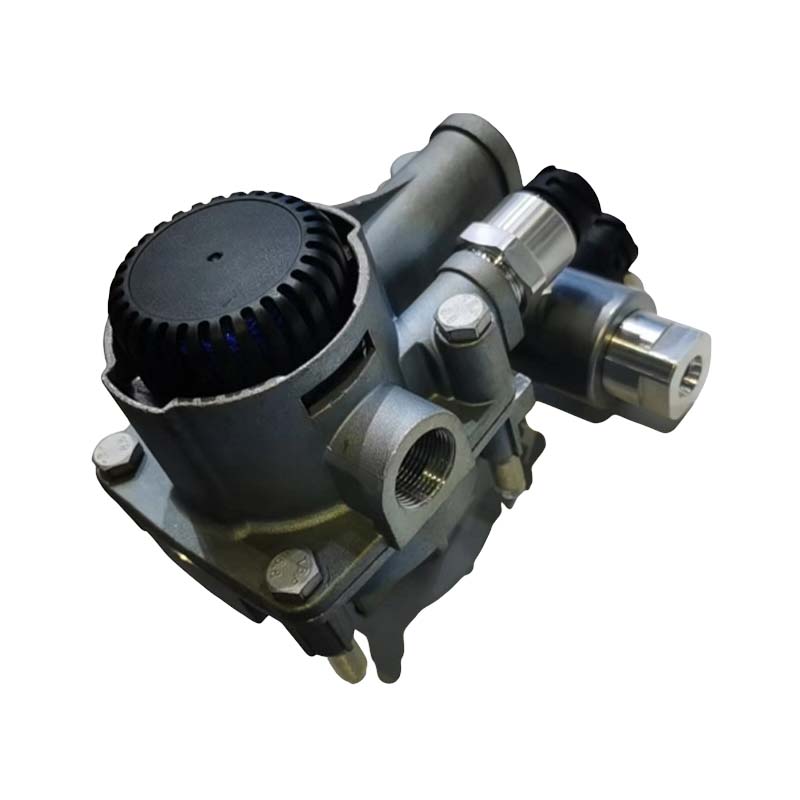
A pneumatic hand brake control valve is the cab-mounted, lever-operated valve that controls the spring brakes of an air-braked truck, tractor or bus. Moving the lever exhausts air from the spring brake chambers to apply the parking brake, and moving it back charges those chambers to release it. Most designs are modulating, so the lever can also apply the spring brakes in graduated steps as an auxiliary brake.
On an air-braked vehicle the parking brake works in the opposite way to the service brake. Powerful springs in the brake chambers try to apply the brake all the time, and compressed air is used to hold them off. The parking brake is therefore applied by letting air out and released by putting air in. The driver needs a control that does this smoothly, holds its position and tells the vehicle electronics what state the brake is in. That control is the hand brake valve, and it is one of the few air valves that the driver touches directly every day.
Exhaust to Apply, Charge to Release
When the lever is in the driving position, the valve connects the supply port to the spring brake delivery ports and closes the exhaust. Air pressure fills the spring brake chambers and compresses the springs, so the brakes are released. Moving the lever toward the park position closes the supply and opens the exhaust seat, and the air in the spring chambers is vented. As the pressure falls, the springs extend and apply the brake. The valve holds the pressure at whatever level matches the lever position.
Lever Positions and Detents
A typical valve has three or four defined positions. The driving position keeps the spring brakes fully released. A graduated zone next to it lets the driver apply the spring brakes progressively. The parking position exhausts the spring chambers fully and locks the lever with a detent so it cannot be knocked out of place. Many valves add a trailer test position, which is described below.
Graduated Braking as an Auxiliary Brake
Because the valve modulates rather than switching fully on or off, the driver can apply the spring brakes gently while the vehicle is moving. This gives an auxiliary braking function that acts on the drive axle if the service brake has failed. It is never a replacement for the service brake, and it is not intended for routine speed reduction, but the graduated behaviour is a required part of the valve design.
The Trailer Test Position
On a tractor unit the hand brake valve often has a second delivery port that controls the trailer supply. In the trailer test position the tractor's spring brakes remain released while the trailer brakes are applied. The driver can then check that the trailer brakes alone are strong enough to hold the combination on a gradient before setting off. It is a simple test, and it is one of the most valuable functions of this valve.
Warning Switches and Indicators
Most hand brake valves incorporate a pressure switch or lever-position switch that operates the parking brake indicator lamp on the dashboard. Some vehicles also use the same signal for interlocks, such as preventing a bus door from opening unless the brake is applied. The switch connector, contact type and operating pressure are therefore as important as the pneumatic ports when matching a replacement.
Matching the Valve to the Cab Layout
Match the number of delivery ports, the lever detent layout, whether a trailer test position is required, the warning switch type and the mounting arrangement in the cab. Valves that share a body but differ in spring stack or detent pattern will feel and behave differently in use, so the OEM part number remains the safest reference.
- Fit point: cab dashboard or console
- Function: modulated control of spring brake chambers
- Lever positions: drive, graduated, park, trailer test
- Ports: supply, delivery to spring brakes, trailer, exhaust
- Electrical options: indicator lamp switch
- Service parts: repair kit, lever, knob, seals