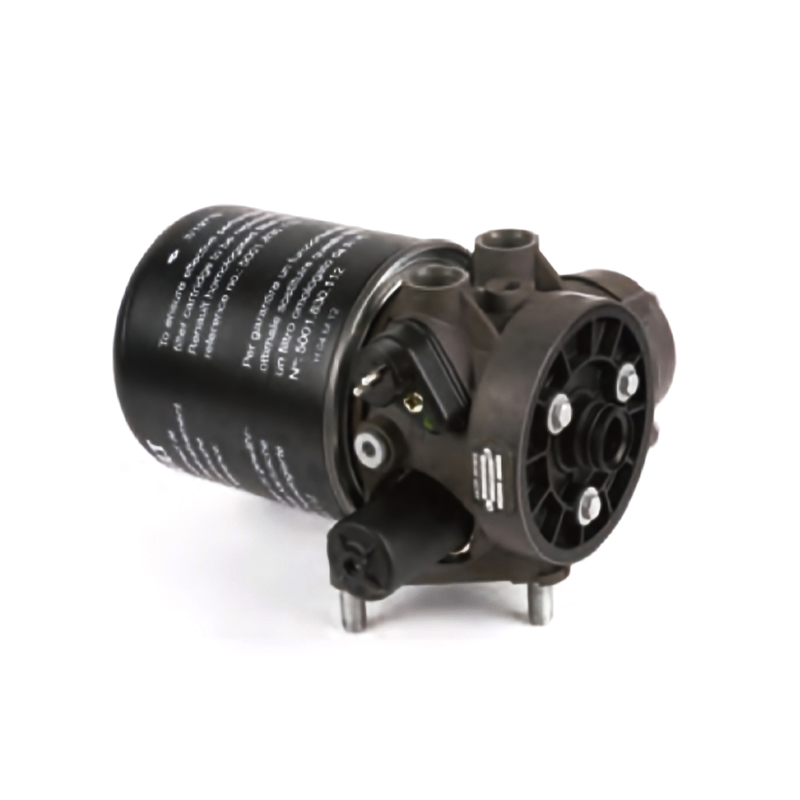
A European truck air brake unloader valve is a pneumatically operated valve fitted to the cylinder head of the engine-driven air compressor. When the governor or pressure regulator signals that system pressure has reached cut-out, the unloader holds the compressor's inlet valve open so the piston keeps moving without compressing air. The compressor idles instead of charging, and the air brake system is protected from over-pressure.
A truck compressor is driven directly by the engine, through a gear train, a belt or the timing case, so it turns whenever the engine turns. Unlike a workshop compressor it cannot simply be switched off once the tanks are full. Without a way to stop delivery, system pressure would keep climbing until the safety valve lifted, wasting engine power and overheating the compressor head. The unloader valve is the component that lets the compressor keep rotating while delivering almost nothing.
Idling Instead of Stopping
When the tanks are full, the governor, or the pressure regulator built into the air processing unit, sends a control signal to the compressor head. That signal acts on the unloader piston or plunger, which pushes the inlet reed or plate valve off its seat. With the inlet held open, air moves in and out of the cylinder on every stroke without being compressed, so delivery drops to almost zero and the power drawn from the engine falls sharply. When system pressure drops to cut-in, the signal is exhausted, a return spring lifts the unloader clear and normal charging restarts.
This idle-and-reload cycle repeats hundreds of times per shift on a distribution truck. The unloader valve is therefore a high-cycle component. Its piston, seat and seals handle constant movement, oil mist, carbon and heat conducted from the cylinder head, which is why seal material and piston fit matter as much as the outer dimensions.
How It Differs from the Governor and the Air Dryer Purge
The three parts are often confused because they act at the same moment. The governor senses pressure and produces the control signal. The unloader valve receives that signal and physically stops the compressor charging. The air dryer purge valve uses the same signal to open and regenerate the desiccant. A fault in one can look like a fault in another, so it helps to know which component does which job before ordering parts.
On vehicles with energy-saving compressor management the control signal comes from a solenoid valve rather than a purely pneumatic governor. The unloader still does the mechanical work, but the vehicle electronics choose the moment of unloading, for example to charge the tanks during engine over-run and let the compressor idle while the engine is under load.
What Happens When the Unloader Fails
An unloader that sticks closed never lets the compressor idle. Pressure climbs past cut-out until the safety valve opens, the compressor runs hot and drive wear increases. An unloader that sticks open or leaks does the opposite: the compressor cannot build pressure, tank fill time grows and the driver sees a slow rise on the gauge. Both faults are commonly mistaken for a worn compressor, and many compressors have been replaced when only a low-cost unloader kit was needed.
Where the Valve Sits on the Compressor
Depending on the compressor family, the unloader may be a screw-in cartridge in the cylinder head, a piston-and-cover module bolted over the inlet plate, or a small pilot valve that controls a larger unloader piston. Single-cylinder units on medium trucks and two-cylinder units on heavy tractors use different piston diameters and control port positions, so the correct type must be matched to the compressor casting number and not simply to the vehicle model.
Matching the Unloader to the Compressor
Match the compressor model or casting number, the control port thread, the piston or cartridge outer diameter, the seal material and the control pressure range. Where a compressor was replaced during the vehicle's life, the unloader on the current compressor may differ from the one listed for the original chassis, so always check the compressor itself.
- Fit point: compressor cylinder head
- Function: holds the inlet valve open at cut-out
- Control source: governor, regulator or solenoid
- Moving parts: piston, plunger, return spring
- Typical failures: sticking, seal leakage, oil fouling
- Service parts: unloader kit, seals, return spring