GongzhengGongzhengGongzhengGongzheng GongzhengGongzhengGongzhengGongzheng GongzhengGongzhengGongzhengGongzheng GongzhengGongzhengGongzhengGongzheng

Pneumatic Check Valves And Control Units Wholesale

One-Way Flow Protection Components

Pneumatic Check Valves And Control Units

Pneumatic check valves and multi-valve control units for truck, tractor and trailer air systems. They protect reservoirs, trailer supply couplings and accessory circuits from backward air loss with a simple, purely mechanical design.

  • Single in-line check valves and multi-valve control units
  • Multiple cracking pressures for different circuit needs
  • Seat and disc kits supplied for field service
1 – 4Check valve positions per control unit
13 barMaximum working pressure
100%Seat leakage tested before shipment
48 HCircuit match reply within two working days
Product Overview

What Is a Pneumatic Check Valve and Control Unit?

Definition

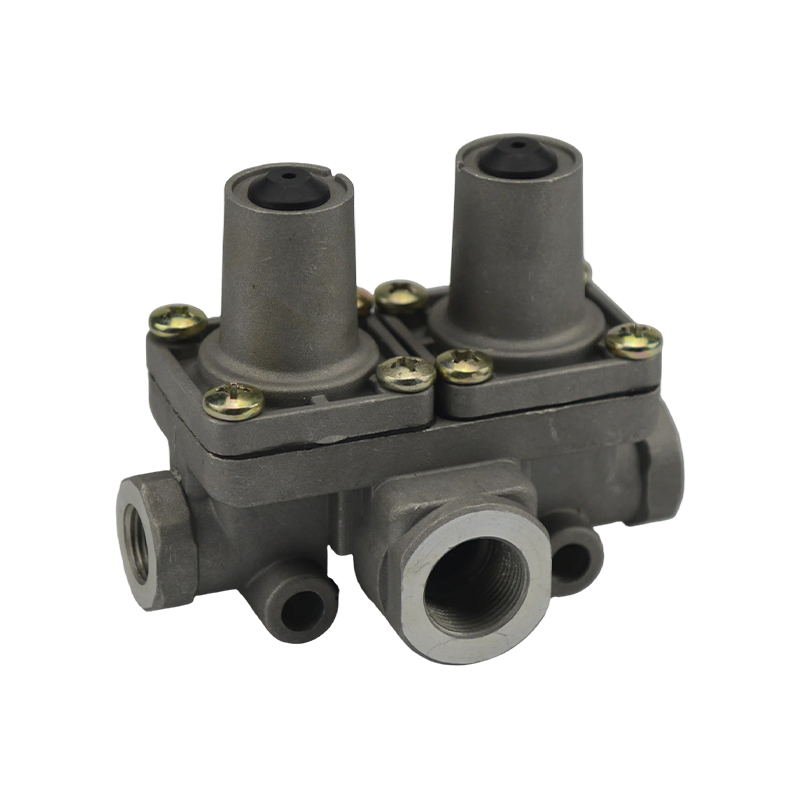
A pneumatic check valve is a one-way valve that lets compressed air flow freely in one direction through a truck's air system while blocking flow in the reverse direction. Control units in this category combine one or more check valves with a small manifold or housing, often adding a test point or a mounting bracket, so that several one-way protection points can be installed and serviced as a single assembly rather than as separate in-line fittings.

A truck air system has many places where air must be allowed to travel one way but never the other. Stored air in a reservoir must not leak backward into a supply line if the source loses pressure. A trailer's own air must not flow back to the tractor through a shared coupling. An accessory circuit must not draw down a brake reservoir if it develops a leak. Each of these situations calls for a simple, purely mechanical device: a check valve, sometimes built alone and sometimes packaged with others into a control unit for convenient installation and testing.

How a Check Valve Works

Inside the housing, a light spring holds a small disc, ball or flap against a seat, blocking the flow path. Air pressure arriving from the permitted direction pushes the disc off its seat, opening the path with very little pressure loss. Air trying to pass the other way pushes the disc harder against its seat, sealing the path completely. No electrical signal, control line or driver action is involved; the valve responds purely to which side has the higher pressure.

Reservoir Protection

A check valve fitted at a reservoir inlet is one of the most common uses on a truck. If the supply line upstream, for example toward the compressor or air dryer, ever loses pressure or is disconneted for service, the check valve stops the reservoir's stored air escaping back through that line, protecting the braking capacity held in that tank.

Coupling and Trailer Supply Protection

Check valves are also used at trailer supply couplings and in accessory circuits, stopping air from one part of the system draining backward into another that has developed a fault. This is closely related to, but simpler than, the function performed by a multi circuit protection valve, and the two are sometimes used together in the same air system.

Control Unit Assemblies

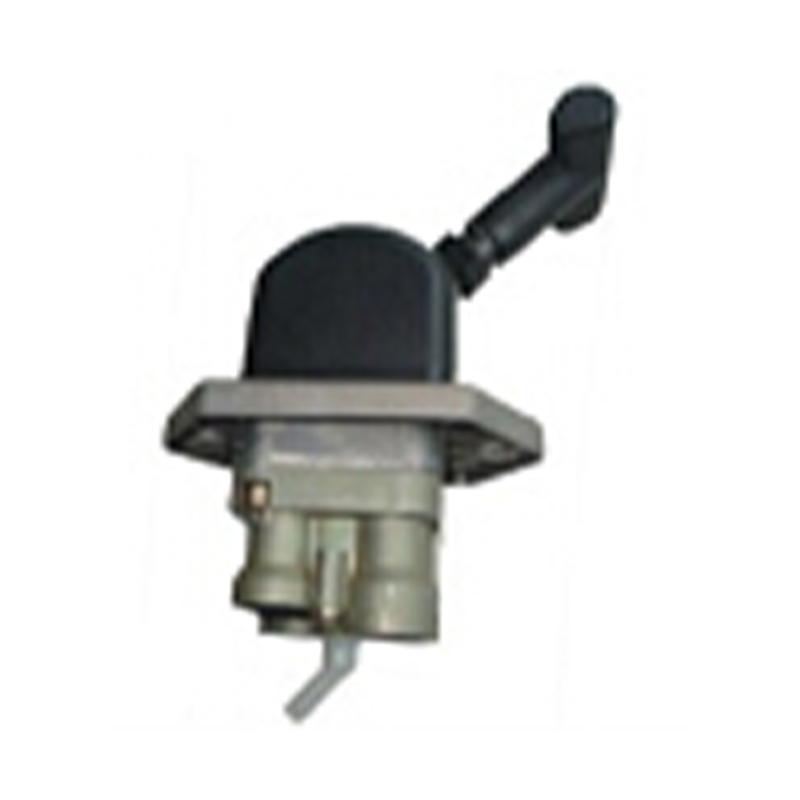
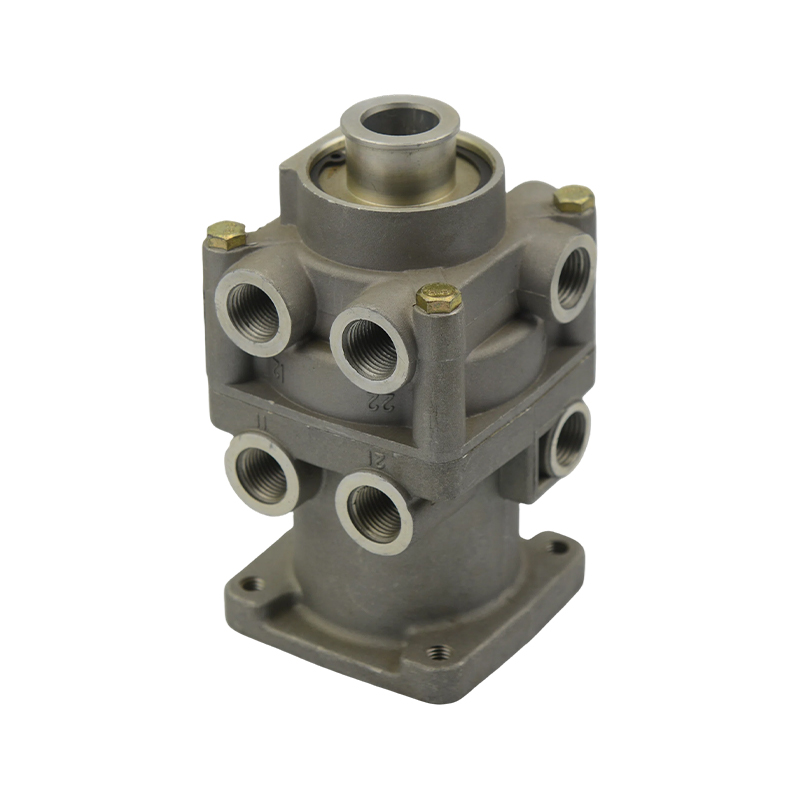
Rather than fitting several individual in-line check valves at different points on a chassis, some applications use a control unit: a small block containing two, three or four check valves in one housing, often with a shared mounting bracket and sometimes a test connection for reading pressure on either side. This simplifies both the original build and later servicing, since one component replaces several separate fittings.

Common Failure Modes

A check valve that leaks in the blocked direction, usually from a worn seat, dirt trapped under the disc, or a weakened spring, defeats its protective purpose without any obvious external symptom until the circuit it protects is tested. A valve that restricts flow excessively in the permitted direction, often from a stiff or misaligned disc, can slow charging of the circuit it feeds.

Matching a Replacement

Match the port thread, the flow direction marking, the cracking pressure (the minimum pressure needed to open the valve) and, for control units, the number of check valve positions and the bracket pattern. Flow direction is marked on the housing and must be respected exactly; fitting a check valve backward will block the circuit entirely.

  • Fit point: reservoirs, couplings, accessory circuits
  • Function: allows flow one way, blocks the reverse
  • Internal part: spring-loaded disc, ball or flap
  • Formats: single in-line valve or multi-valve control unit
  • No electrical or control signal needed
  • Service parts: seat and disc kit, or complete replacement

Technical Data

Check Valve and Control Unit Model Range

Standard configurations below. Custom cracking pressures and port arrangements can be produced to your drawing.

Table 1 — Genuine gzbrake.com Ref NO. and OE cross-reference data for representative European Control Valve & Checking Valve products.

Ref NO.Product NameApplicationTechnical SpecificationOE / Cross-Reference (Sample)Cross-Ref. CountProduct Line
4630131120Truck Parts Check ValveRVIPort 1,2,3 = 3xM12x1.5,Stem Length = 37.9mmRVI:5021170180Volvo 6645266Man 4086378Iveco 2564591Knorr AE12061European Control Valve & Checking Valve
4630131140Stainless Steel Check Valve for TruckVOLVOPort 1,2,3 = 3xM12x1.5,Stem Length = 95.6mmVOLVO:1132041Daf 1518078Mercedes 00043005091European Control Valve & Checking Valve
46301320003/2 Button Valve for DAF/MERCEDES SeriesDAFPort 1,2 = 2xM16x1.5VOSS,Port 3 = M12x1.5,Stem Length = 41mmDAF:1505077Mercedes 00043438011European Control Valve & Checking Valve
4630220200 Stainless Steel Durable Truck Check ValveDAFPorts 1,2 = 2xM10x1,Stem Length = 42mmDAF:0642909Volvo 2687591European Control Valve & Checking Valve
0481007057Check Valve for TruckIVECOPorts 1,2 = 2xM12x1.5IVECO:8188610 58012791521European Control Valve & Checking Valve
CP6A3/2 Control Valve for IVECO SeriesIVECOPorts 1,2 = 2xM12x1.5,Stroke = 4.5mmIVECO:58012791521European Control Valve & Checking Valve
4630360000Air Brake Check ValveRVIPort 1,2 = 2xM10x1,Mounting = M28x1.5,Actuating Knob: BlackRVI:5000806404Man 81521866015Iveco 21403020171European Control Valve & Checking Valve
4630360050Knob-Operated 3/2 Control Valve for DAF/MERCEDESDAFPort 1,2 = 2xM16x1.5VOSS,Port 3 = M10x1,Mounting = M28x1.5,Actuating Knob: BlackDAF:1506104Mercedes 00399722261European Control Valve & Checking Valve

Ref NO. and cross-reference numbers above are drawn directly from our European Control Valve & Checking Valve product range on gzbrake.com. Cross-reference lists are sampled for space; contact us with your vehicle's OE number or chassis details for the complete, current cross-reference list and stock availability.

Common Application Coverage

Air Reservoir InletTrailer Supply CouplingAccessory Circuit FeedAir Dryer Delivery LineAuxiliary Tank ProtectionCab Suspension CircuitSeat Suspension FeedHorn Supply LineDoor Actuator CircuitPTO Air SupplyFifth Wheel Lubrication CircuitTank Drain ProtectionMulti Circuit ManifoldParking Brake FeedAuxiliary Compressor FeedRetarder Air SupplyKneeling System FeedTail Lift Air Supply
About Us
Zhejiang Gongzheng Machinery Co., Ltd.
Zhejiang Gongzheng Machinery Co., Ltd. is professional China Pneumatic Check Valves And Control Units Manufacturers and Wholesale Pneumatic Check Valves And Control Units Factory. Our core products include ABS (Anti-lock Braking System) and EBS (Electronic Braking System) control units, air dryers, air brake valves, and spring brake chambers, designed to meet the rigorous demands of the global commercial vehicle industry.

With advanced production technology, strict quality control, and a commitment to innovation, we provide reliable and efficient solutions for truck and trailer manufacturers worldwide. Our products comply with international standards, ensuring safety, durability, and superior performance in diverse operating conditions.

Key Products:
ABS & EBS Control Systems – Enhancing vehicle safety and stability.
Air Dryers – Ensuring clean, moisture-free air for braking systems.
Air Brake Valves – Precision-engineered for optimal braking performance.
Spring Brake Chambers – Robust design for heavy-duty applications.
At Zhejiang Gongzheng Machinery, we prioritize customer satisfaction, technological advancement, and sustainable growth. Partner with us for trusted braking solutions that drive excellence.

Safety. Reliability. Innovation.
  • 0m2
    Factory Area
  • 0+
    Founded In
  • 0+
    Number of Employees
  • 0+
    Customer Service
Working Principle

How a Check Valve Protects the Circuit

The valve responds only to pressure difference across it. Four stages describe normal operation and a fault condition.

Normal Flow

Air arrives from the permitted direction at a pressure above the cracking pressure and pushes the disc off its seat, passing through with minimal restriction.

Balanced or Reverse Pressure

If pressure on the outlet side rises to match or exceed the inlet side, the disc returns to its seat under spring force, closing the path.

Protected Reservoir Condition

If the supply side loses pressure entirely, the higher pressure held in the protected reservoir or circuit keeps the disc firmly seated, and no air escapes backward.

Fault Condition: Worn Seat

If the seat or disc is worn or contaminated, some air leaks backward even under normal conditions, slowly reducing the pressure the check valve was meant to protect.

Multi-Position Control Units

On a control unit with several check positions, each behaves independently, so one circuit can protect correctly while a neighbouring position leaks if its own seat is worn.

What Happens When a Check Valve Fails

  • A worn seat lets stored air leak backward, meaning a reservoir loses capacity it was meant to retain during a supply fault.
  • A stuck-closed valve blocks the circuit entirely, preventing normal charging in the intended direction.
  • Dirt trapped under the disc can cause intermittent leakage that is difficult to reproduce during a quick test.
  • A control unit with one failed position among several can appear to work normally on a general pressure check while one specific protection point is compromised.
  • A check valve fitted backward by mistake blocks its circuit completely and is usually discovered immediately during commissioning.
Product Features

Simple, Reliable Protection With No Moving Electronics

A check valve has no electrical parts and very few components, which is exactly what makes it dependable when properly maintained.

Precision Seat and Disc

A carefully machined seat and disc combination gives low cracking pressure and minimal leakage in the closed direction.

Multiple Cracking Pressures

A range of spring rates suits reservoir protection, coupling protection and accessory circuit applications.

Single and Multi-Position Formats

In-line single check valves and 2, 3 or 4-position control units cover both simple and complex protection needs.

Test Connection Option

Selected control units include a test point for reading pressure on either side without disconnecting a line.

Corrosion-Resistant Materials

Brass and treated aluminium bodies resist road salt and moisture over long service life.

Clear Flow Direction Marking

An arrow or marking on every housing makes correct orientation straightforward during installation.

Selection Guide

How to Choose the Right Check Valve or Control Unit

Four checks decide whether the valve protects the correct circuit without unduly restricting normal flow.

  • 01

    Confirm the flow direction needed

    Identify clearly which direction must be blocked and which must flow freely. This decides the orientation of installation, marked on the housing.

  • 02

    Choose an appropriate cracking pressure

    A lower cracking pressure suits circuits where minimal pressure loss matters; a higher cracking pressure suits circuits needing a firmer seal against back-flow.

  • 03

    Decide between single valve and control unit

    Where several protection points are needed close together, a multi-position control unit simplifies installation and future servicing.

  • 04

    Match the port thread and flow capacity

    Confirm the thread size and that the valve's flow capacity suits the circuit it serves, since an undersized check valve can restrict normal charging.

  • 05

    Check for a test connection requirement

    If the workshop needs to read pressure on either side without breaking a line, choose a control unit with an integrated test point.

Table 2 — Application and typical check valve configuration.

ApplicationTypical ConfigurationNote
Reservoir inlet protectionSingle in-line, low cracking pressureProtects stored braking air
Trailer coupling protectionSingle in-line, moderate cracking pressureFitted near the coupling head
Multi-reservoir truck3 or 4-position control unitSimplifies multiple protection points
Accessory circuitSingle in-line valveProtects brake reservoirs from accessory leaks
High-flow reservoir feedSingle in-line, larger portMinimises pressure loss on large tanks

Configurations are typical and vary by vehicle design. Always confirm against the air circuit diagram.

Applications

Where These Check Valves and Control Units Are Fitted

Any point in the air system where backward flow must be prevented can use a check valve. Here are the circuits where we supply them most.

Air Reservoir Inlets

Protects stored braking air from escaping backward if the supply line upstream loses pressure.

Trailer Supply Couplings

Stops trailer reservoir air draining back toward the tractor if the supply line is disconnected or damaged.

Accessory Circuits

Prevents a leak in a lower-priority circuit, such as an air horn or door cylinder feed, from drawing down brake reservoirs.

Multi-Reservoir Trucks

Control units simplify protection across several tanks feeding different circuits on the same chassis.

Auxiliary Compressor Systems

Protects the main air system from a fault in an auxiliary compressor or its delivery line.

Cab and Seat Suspension Circuits

Prevents comfort circuits from drawing air away from safety-critical reservoirs during a fault.

Fifth Wheel and PTO Circuits

Protects the main system from leaks in specialised auxiliary functions on vocational vehicles.

Fleet Overhauls

Replacing a leaking or contaminated check valve restores intended one-way protection at low cost.

Installation

Installation Notes for Workshops

A check valve is simple, but getting the orientation and location right is essential to its function.

Depressurise the Circuit

Drain the relevant reservoir or line and confirm zero pressure before disconnecting any fitting.

Confirm Flow Direction

Check the arrow or marking on the housing against the intended flow direction before fitting; a reversed valve blocks the circuit entirely.

Clean the Line

Blow through the pipe before fitting to remove debris that could lodge under the disc and cause leakage.

Fit New Seals

Use new sealing washers or O-rings at every port to avoid slow leaks that are hard to trace later.

Mount Securely

Support the valve or control unit properly so vibration does not fatigue the connecting lines over time.

Test in Both Directions

Charge the protected side and confirm it holds pressure with the supply side drained, then confirm normal flow charges correctly in the permitted direction.

Quality
Components
Service Life
Professionalism
Delivery
Customization
Inventory
Why Gongzheng Only

By cooperating with us, you can obtain

Your Single Source for Braking Performance and Safety.

The ISO quality management system covers every process. We have obtained certifications such as Germany's TUA, ensuring that both original equipment and after-sales products meet the strict quality standards of commercial vehicle manufacturers.

Quality

Over 70% of the components for our products are manufactured in-house, which guarantees product quality.

Components

High-quality raw materials, precise calculation, professional design, and strict production testing ensure that all products manufactured by Gongzheng Jinggong are durable.

Service Life

We have long provided direct supporting services for large enterprises. Our long-term close cooperation with commercial vehicle brands and manufacturers in R&D and testing has made us more professional and experienced.

Professionalism

Automated production and accurate, fast logistics services are sufficient to meet customer requirements.

Delivery

We have an independent R&D team. In addition to standard parts, we also offer customization services to meet customers' special needs.

Customization

We maintain a standing inventory of over 200,000 units, enabling us to handle large-volume orders and urgent orders.

Inventory
Maintenance

Check Valve Inspection and Replacement Schedule

Because a leaking check valve produces no obvious symptom until the circuit it protects is actually tested, routine checks matter more than they might first appear.

Table 3 — Recommended inspection and replacement schedule for pneumatic check valves and control units.

ItemIntervalWhat to Check
Reservoir isolation testEvery 12 monthsIsolate the supply side and confirm the protected reservoir or circuit holds pressure without leaking back.
Housing and fittingsAnnual inspectionCheck for corrosion, cracks and loose connections, especially at trailer couplings.
Flow direction markingWith each disturbanceConfirm the arrow or marking is still legible and the valve remains correctly oriented after any line work.
Test connection readingEvery 12 monthsOn control units with a test point, compare pressure readings on both sides against expectations.
Seat and disc conditionEvery 3 years or 300,000 kmReplace with a seat and disc kit if leakage is found during the isolation test.
Control unit position checkEvery 12 monthsTest each check valve position within a multi-valve unit individually where possible.
Mounting bracketAnnual inspectionCheck for looseness and corrosion, particularly on chassis-mounted control units.

We supply seat and disc kits and complete replacement check valves and control units for every model listed on this page.

Diagnostics

Check Valve Troubleshooting Guide

Because a check valve is purely mechanical, most faults trace back to a worn seat, contamination or an installation error.

Table 4 — Common check valve and control unit symptoms, causes and corrective actions.

SymptomLikely CauseRecommended Action
Reservoir loses pressure when supply is isolatedWorn seat, damaged disc or contamination under the disc.Clean or replace the seat and disc kit, or fit a new valve.
Circuit does not charge at allValve fitted backward, or completely blocked by debris.Check the flow direction marking and clean or replace the valve.
Slow charging in the permitted directionUndersized valve for the flow, or a stiff or misaligned disc.Confirm the valve is correctly sized and free-moving.
Intermittent pressure lossDebris intermittently lodging under the disc.Clean the valve internals or replace with a new unit.
One position in a control unit leaks while others are fineLocalised seat wear or damage in that specific position.Test each position individually and replace the affected seat and disc, or the whole unit if not serviceable.
Valve chatters or buzzes under flowWeak or damaged spring, or a disc that is loose in its guide.Replace the valve or the internal spring and disc assembly.
Corrosion visible on the housingProlonged exposure to moisture and road salt.Replace the valve and consider a more corrosion-resistant material grade for the application.
Test connection shows unexpected pressureLeaking check valve position or a fault elsewhere in that circuit.Isolate the circuit section by section to locate the actual source of the reading.

If a circuit still loses pressure after the check valve is replaced, inspect the reservoir, its drain valve and the connecting lines for a separate leak.

Terminology

Check Valve Glossary

Plain-language definitions of the terms you will see on air circuit diagrams, workshop manuals and part listings.

Check Valve
A one-way valve that allows air to flow in one direction and blocks flow in the reverse direction.
Cracking Pressure
The minimum pressure difference needed to lift the disc off its seat and allow flow.
Control Unit
A housing containing two or more check valves, often with a shared bracket and sometimes a test connection.
Seat
The surface against which the disc, ball or flap seals to block reverse flow.
Disc
The moving element, sometimes a ball or flap instead, that opens and closes against the seat.
Flow Direction Marking
An arrow or symbol on the housing showing the permitted direction of flow.
Test Connection
A port on some control units used to read pressure on either side of a check valve without disconnecting a line.
Reservoir Protection
The function of preventing stored air in a tank from escaping backward through a failed supply line.
Back-Flow
Air attempting to travel in the blocked direction through a check valve.
In-Line Valve
A single check valve fitted directly into a pipe run, as opposed to a multi-position control unit.
Multi Circuit Protection Valve
A related but more complex component that distributes and isolates whole brake circuits, sometimes used alongside simple check valves.
Isolation Test
A test that drains the supply side of a check valve and checks whether the protected side holds pressure.
Questions

Frequently Asked Questions

Twelve questions our distributors, workshops and fleet buyers ask most often about pneumatic check valves and control units.

It allows compressed air to flow in one direction only, protecting a reservoir or circuit from losing air backward if the supply side develops a leak or is disconnected.

A check valve is a single one-way valve. A control unit packages two, three or four check valves into one housing, simplifying installation and servicing where several protection points are needed close together.

The housing carries an arrow or marking showing the permitted flow direction. Installing it backward will block the circuit entirely rather than protect it.

It is the minimum pressure needed to open the valve in the permitted direction. A lower cracking pressure minimises pressure loss, while a higher cracking pressure gives a firmer seal against back-flow, so the choice depends on the application.

Charge the protected side, then isolate or drain the supply side and watch whether the protected pressure holds steady. A falling reading indicates a leaking check valve.

Yes, if the valve restricts flow more than expected in the permitted direction, due to a stiff disc or an undersized valve for the circuit's flow requirement.

Yes, for many models. A seat and disc kit restores sealing without replacing the complete valve, provided the housing itself is undamaged.

On some designs yes, since positions are individually serviceable. On others the complete unit must be replaced. Confirm with us which applies to your specific model.

Yes. Send a photo of the valve or control unit together with the circuit it serves, and our technical team will confirm the matching model and reply within two working days.

They need periodic testing rather than active servicing, since they have no scheduled wear items beyond the seat and disc, which should be checked as part of an isolation test on the schedule shown above.

Stocked models normally leave within 3 to 7 working days of payment. Small trial orders are welcome, and non-standard configurations are quoted with a delivery date on the proforma invoice.

Yes. We can produce valves and control units with alternative cracking pressures and port arrangements to your drawing, and supply them in neutral cartons or under your own brand.

Need the right check valve or control unit for your circuit?

Send us the circuit diagram, the required cracking pressure or a photo of the existing valve, and we will get back to you with the matching model within 48 hours.