


 Français
 Español
 中文简体
 русский

Gongzheng
Gongzheng
Gongzheng
Gongzheng
Gongzheng
Gongzheng
Gongzheng
Gongzheng
Gongzheng
Gongzheng
Gongzheng
Gongzheng
Gongzheng
Gongzheng
Gongzheng
Gongzheng
Industry News
How Do You Know If Your Air Dryer Is Bad? Five Checks That Confirm the Fault

Content
- 1 The Five Checks That Confirm a Bad Air Dryer
- 2 What the Dryer Actually Does Before It Fails
- 3 Check One: The Tank Drain Test
- 4 Check Two: Purge Cycle Timing and the Exhaust Port
- 5 Check Three: Build-Up Time and Cut-Out Pressure
- 6 Check Four: Oil Mist, Black Powder and Desiccant Beads
- 7 Check Five: Winter Freezing and the Heater Circuit
- 8 Cartridge, Assembly or Compressor: The Replacement Decision
- 9 Choosing the Right Replacement Unit
- 10 European and American Platform Differences That Affect Diagnosis
- 11 Service Intervals and What Actually Extends Dryer Life
- 12 Common Mistakes During Diagnosis and Replacement
- 13 Frequently Asked Questions
- 13.1 How long does an air dryer last before it needs replacing?
- 13.2 Can I drive with a bad air dryer?
- 13.3 Why does my dryer purge so often?
- 13.4 Why is there oil in my air tanks?
- 13.5 Does a bigger air dryer improve brake performance?
- 13.6 What causes beads to appear in the air line?
- 13.7 Can a bad dryer cause a low pressure warning?
A healthy air dryer purges for roughly one second every 60 to 90 seconds, pushes dry warm air out of the exhaust port, and leaves the inside of every reservoir bone dry. A bad air dryer breaks one of those three behaviours first, and which one it breaks tells you almost exactly what has failed inside the housing before you loosen a single bolt.
The five checks below are ordered by how quickly they can be done and how much they tell you. A stopwatch, a clean plastic cup, a tyre gauge and a multimeter cover all of them. None require lifting the cab.
The Five Checks That Confirm a Bad Air Dryer
01
The tank drain spits water
Water, milky emulsion or a steady trickle from a reservoir drain after an overnight stand means the desiccant has stopped absorbing. This is the single most reliable symptom.
02
Purge cycle is too short
A dryer cycling every 15 to 30 seconds instead of every 60 to 90 seconds is either leaking internally, stuck on the unloader, or fighting a system leak it cannot win.
03
Build-up time has stretched
Slow pressure recovery from zero, or a governor that cuts out early, points to a restricted dryer or a worn compressor. The test below separates the two.
04
Oil mist or black powder downstream
Oil mist saturates desiccant in weeks. Black or grey powder past the dryer means the support screen has failed and abrasive beads are travelling toward the valves.
05
Winter freeze or a dead heater
Ice at the exhaust port, a frozen purge valve or a heater drawing no current at all are all signs the thermal circuit, not the desiccant, has failed.
| Symptom you observe | Most likely cause inside the dryer | Fastest confirmation | Typical action |
|---|---|---|---|
| Water in reservoir drains | Desiccant saturated or oil coated | Overnight stand, then drain into a cup | Replace cartridge or assembly |
| Purge every 20 to 30 seconds | Unloader seat leak or internal seal wear | Stopwatch on the purge cycle at idle | Inspect unloader; measure leak-down |
| Slow pressure build from zero | Restricted dryer body or worn compressor | Repeat build-up with dryer bypassed | Replace dryer if time recovers |
| Oil mist at the delivery port | Compressor passing oil, desiccant blinded | White cloth test at the delivery line | Repair compressor, replace dryer |
| Beads or powder in the line | Broken support screen or failed felt pad | Swab the delivery port and first valve | Replace assembly, flush the circuit |
| Exhaust frost in cold weather | Heater open circuit or thermostat failed | Multimeter across the heater terminals | Replace heater or whole unit |
What the Dryer Actually Does Before It Fails
A compressor takes ambient air at 20 degrees and 60 percent relative humidity and compresses it to 8 to 12 bar. Compression raises the temperature well above 100 degrees, so the air leaves the compressor carrying far more water vapour than the atmosphere it came from. The dryer exists to remove that vapour before it can condense in a reservoir, a valve body or a brake chamber.
The process happens in four stages inside one housing, and each stage fails in a different way:
- Cooling and condensation. Hot compressed air passes through an inlet chamber or a coiled section where it loses heat to the housing. Water drops out here as liquid and is swept along by the airflow.
- Coalescing. A coarse filter element gathers the liquid droplets and any oil carry-over into larger beads that fall to the sump instead of travelling onward.
- Adsorption. The desiccant bed, usually activated alumina or a molecular sieve, holds the remaining vapour. A typical commercial vehicle dryer holds enough desiccant to manage 30 to 60 litres of water vapour between regeneration events under normal duty.
- Regeneration and purging. When the governor signals that the system is full, the dryer switches to unload, a small volume of dry air is pushed back through the bed, and the purge valve opens to blow the released moisture out of the exhaust port.
Everything that goes wrong with an air dryer is a failure of stage two, three or four. Stage one almost never fails because there are no moving parts, which is why diagnosis starts with whether the bed is still adsorbing, whether the purge valve is still sealing, and whether the regeneration air is still flowing.
Why desiccant stops working well before it looks dirty
Activated alumina holds roughly 15 to 20 percent of its own weight in water before it reaches breakthrough. On a tractor pulling a dry van in a humid climate, that point can arrive in 12 to 18 months of normal service. The cartridge still looks structurally intact when it is removed, which is why visual inspection alone misleads so many workshops. The bead is still there, still the right colour on the outside, and completely unable to hold another gram of vapour.
Oil contamination accelerates this dramatically. Compressor carry-over coats each bead with a film that blocks the pore structure. A dryer running behind a compressor that is passing oil loses its capacity in a fraction of the normal interval, and the failure looks sudden to the driver even though it has been building for months.
Check One: The Tank Drain Test
This is the test that settles the question fastest, and it costs nothing to run. Park the vehicle overnight so the system cools completely, then in the morning charge the system to governor cut-out, shut the engine down and drain the first reservoir into a clean transparent cup.
- Let the vehicle stand for at least 12 hours so any vapour in the system has time to condense.
- Run the engine until the governor cuts out, then switch off.
- Open the drain cock on the primary wet tank and catch the first 50 millilitres.
- Repeat for the secondary and, if fitted, the trailer reservoir.
- Hold the cup against a white surface and look at what settles.
What you should see is a fine mist of condensation, perhaps a thin film at the bottom of the cup, and nothing more. A dry system is normal. What you should not see is a continuous liquid stream, a milky emulsion, or more than about a thimbleful of free water from a tank that was dry the week before.
Field reference point: a reservoir that releases a continuous stream of water for more than a second, or that produces more than a couple of millimetres of standing water in the cup, is telling you that the desiccant bed is no longer adsorbing. Replacing the cartridge is the first move. Replacing the cartridge and finding water back within two weeks means the dryer is being flooded from upstream and the compressor needs inspection.
The same moisture shows up at the drain valve on the condenser and separator side of the system. If moisture is reaching the condenser drain, the automatic drain valve is doing its job but the dryer ahead of it is not. A working condenser drain valve removes what condenses; it cannot remove what never condensed in the first place.
Check Two: Purge Cycle Timing and the Exhaust Port
Start the engine, let the system reach cut-out pressure, and time the interval between purge events with the engine idling and no air consumers running. A healthy dryer purges once every 60 to 90 seconds on a tractor-trailer combination. The purge itself should last about one second and sound crisp and short.
Healthy dryer
70 to 90 s
Worn cartridge
40 to 55 s
Leaking unloader
15 to 25 s
Stuck closed
no purge
Two faults pull the interval in opposite directions, and the difference matters for diagnosis. A shortened interval with a strong purging sound usually means the unloader seat is leaking, so the system never fully reaches cut-out and the governor keeps recycling the dryer. A lengthened interval, or no purge at all, means the purge valve is stuck shut or the signal line from the governor is blocked.
Then listen at the exhaust port with the system fully charged and the engine off. A continuous hiss is not a normal purge. It is a seat that is not closing, and it will cost you pressure all day. The usual causes are a worn purge valve seat, a swollen O-ring, or contamination holding the valve off its seat. On a unit older than five years, the seat and O-ring set is a cheap fix and worth trying before condemning the whole housing.
Separating a dryer fault from a system leak
Charge the system, shut the engine down, and watch the gauge for ten minutes without touching the brake pedal. A drop of more than 0.5 bar in ten minutes is a system leak, not a dryer fault, and no amount of dryer replacement will fix a leaking glad hand or a seeping chamber diaphragm. Only when the system holds pressure properly but the dryer still cycles too fast should you look inside the dryer.
Check Three: Build-Up Time and Cut-Out Pressure
Build-up time is the interval from zero to governor cut-out with the engine at operating speed. A typical tractor with four reservoirs should reach cut-out in 60 to 90 seconds from empty. Write down the actual number, because the trend over months is more revealing than any single reading.
A restricted dryer body, a collapsed cartridge or a blocked delivery check valve all stretch build-up time in the same way, and they can be separated with one simple step: repeat the test with the dryer bypassed using a temporary line. If the time drops back into the normal window, the restriction is in the dryer. If it stays long, the compressor is worn, the intake is blocked, or the governor is set too low.
Build-up curves from an empty system at operating speed. The gap between the two curves widens after the second reservoir fills, which is where a restricted dryer shows itself.
Cut-out pressure is the second reading to record. Governor cut-out on most commercial vehicles sits between 8.0 and 8.5 bar, with cut-in around 6.5 to 7.0 bar. If the dryer's unloader is not releasing properly, cut-out can creep above specification and the safety valve will start venting. If the internal check valve is leaking back, the compressor will run continuously and the gauge will never settle.
Check Four: Oil Mist, Black Powder and Desiccant Beads
Disconnect the delivery line at the dryer outlet and hold a clean white cloth in front of the port while an assistant briefly runs the engine. A dry, clean cloth is what you want. A cloth with a grey or black film is showing you oil carry-over, and that oil has already been through the desiccant bed.
Oil contamination deserves its own explanation because it is the most misdiagnosed air dryer failure in service today. The compressor lubricates its own cylinder walls, and a small quantity of oil vapour always leaves with the discharge air. A healthy dryer's coalescing element separates most of it and returns it to the sump. When the coalescing element is saturated or the return line is blocked, that oil passes into the desiccant. The beads become hydrophobic in patches, capacity falls off a cliff, and water starts reaching the reservoirs while the dryer still looks perfectly serviceable from the outside.
Grey film on the cloth
Light oil carry-over. The coalescing element is saturated. Replace the cartridge and check the compressor oil return line for blockage.
Black or sooty deposit
Heavy carry-over, often with carbon from a worn compressor. The dryer is a symptom. Repair or replace the compressor before fitting a new unit.
Gritty beads in the line
The support screen or felt pad has failed. Beads travel downstream and score valve bores. Flush the circuit and inspect every component the air passes through.
Bead carry-over is the fault that does the most expensive damage. Alumina beads are hard, abrasive and slightly larger than the clearances inside a relay valve. Once they are loose in the circuit they find the foot brake valve, the relay valve and the ABS modulator, and the repair bill grows with every component they touch. Any evidence of beads past the dryer outlet means the whole assembly gets replaced, not just the cartridge.
Check Five: Winter Freezing and the Heater Circuit
Cold weather exposes a different set of failures. Condensation that forms in the exhaust port or the purge valve gallery can freeze overnight and lock the valve shut. The vehicle starts in the morning, the compressor builds pressure, and the dryer cannot purge because the valve is frozen open or closed.
Most commercial vehicle dryers carry a 24 volt electric heater in the base to keep the purge valve area above freezing. It is a simple resistive element controlled by a thermostat or a temperature switch, and it fails in one of two ways: open circuit, so it never heats, or shorted, so it heats all the time and eventually burns out the thermostat.
- Disconnect the heater connector with the ignition off.
- Set a multimeter to resistance and measure across the two heater terminals.
- An open reading means the element has failed and the dryer will freeze in any sustained sub-zero weather.
- A reading in the typical cold resistance range means the element is probably intact and the fault lies in the thermostat, the wiring or the supply fuse.
- With the ignition on and the engine cold, check for supply voltage at the connector. No voltage means the fault is upstream, not in the dryer.
Freezing is not only a heater problem. Water that should never have been in the system is the root cause, and a dryer that is already saturated will freeze even with a working heater. If the vehicle freezes up every winter and the heater tests good, the desiccant is the place to look.
Cartridge, Assembly or Compressor: The Replacement Decision
Once you have confirmation, the next decision is what to replace. Replacing a cartridge on a housing that has failed internally wastes a service interval. Replacing a complete assembly when the cartridge alone would do wastes money. The matrix below resolves most cases.
| Finding | Cartridge only | Complete assembly | Compressor work first |
|---|---|---|---|
| Water in drains, clean housing, heater good | Yes | No | No |
| Water returns within two weeks of a new cartridge | No | Yes | Inspect |
| Oil film at the delivery port | No | Yes | Yes |
| Beads or powder downstream | No | Yes | No |
| Purge valve leaking continuously | Seat kit first | If seat is scored | No |
| Cracked housing or corroded ports | No | Yes | No |
| Heater open circuit, housing sound | Heater or base only | Optional | No |
There is an economic argument that workshops rarely make explicitly. A cartridge replacement restores capacity for roughly the normal service interval, provided the housing, purge valve, heater and check valve are all healthy. Once two or more of those items need work, the labour and parts add up to most of the cost of a complete heavy-duty truck air dryer assembly, and the assembly comes with a fresh valve, a fresh heater and a fresh check valve.
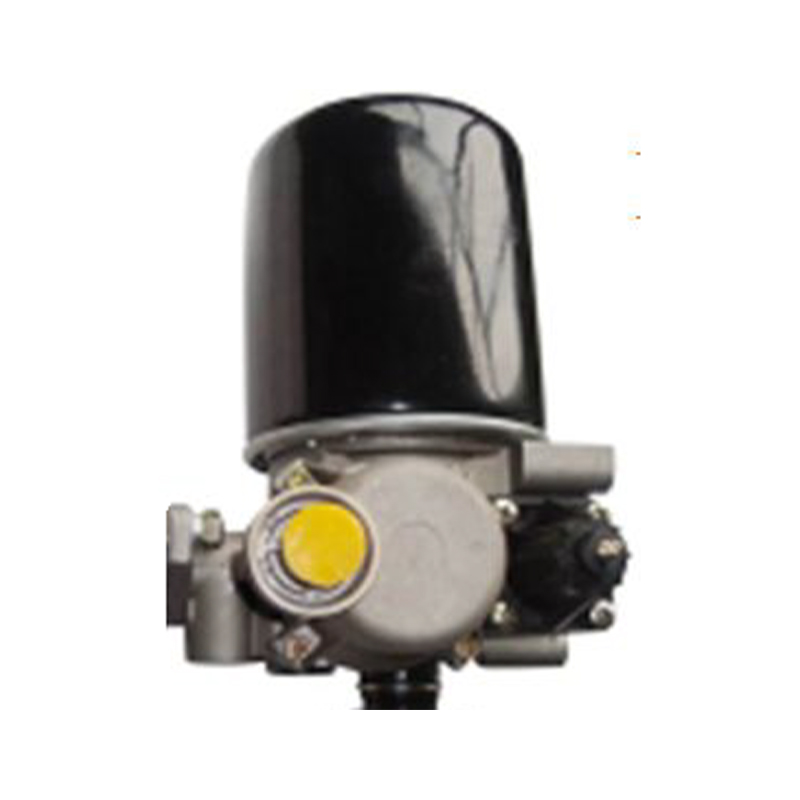
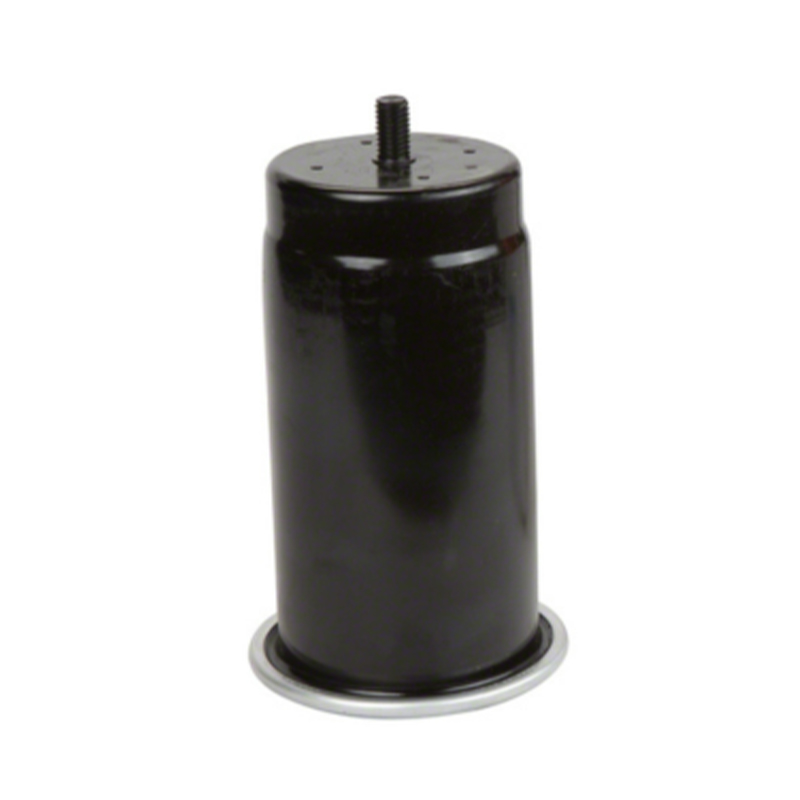 AD-9 Series Replacement Air Dryer Cartridge A00007A direct replacement for AD-9 style air dryer assemblies with coalescing desiccant protection, suited when the housing and purge components remain healthy.View Product →
The AD9 pattern cartridge is the volume seller in North American service because so many tractors use that housing. The important checks before ordering are the cartridge height, the seal diameter and the number of locating lugs. A cartridge that fits the bore but seals at the wrong depth will pass air straight past the desiccant bed and behave exactly like a failed unit from the first kilometre.
Choosing the Right Replacement Unit
Air dryers are not interchangeable across platforms, and the differences that matter are all physical rather than cosmetic. Getting any one of the following wrong produces a unit that bolts up and then fails to perform.
Port standards and thread forms
European platforms generally use metric threads with seal rings, and VOSS style interfaces appear frequently on DAF, Mercedes and Volvo installations. North American platforms typically use NPT or PTF tapered and straight threads, and the two are not interchangeable without adapters. Measure the existing port, confirm the thread form, and check that the replacement has the same number and orientation of ports, including the delivery, supply, unloader signal and any tyre inflation outlet.
Voltage and heater configuration
A 12 volt dryer on a 24 volt chassis will destroy its heater in minutes. Confirm the vehicle voltage, then confirm whether the heater is controlled by an internal thermostat, an external temperature switch or the engine ECU. Some integrated air processing units also carry a pressure sensor and a silencer, and swapping to a unit without those features leaves the harness dangling and the ECU logging faults.
Integrated air processing unit or standalone dryer
An integrated unit combines the dryer, the multi-circuit protection valve, the pressure regulator and often the sensor in one body. It saves space and eliminates several pipe joints, but it also makes diagnosis less granular because a fault in any one function affects the whole unit. A standalone dryer paired with a separate four-circuit protection valve is easier to service and cheaper to repair, at the cost of more pipework and more potential leak points.
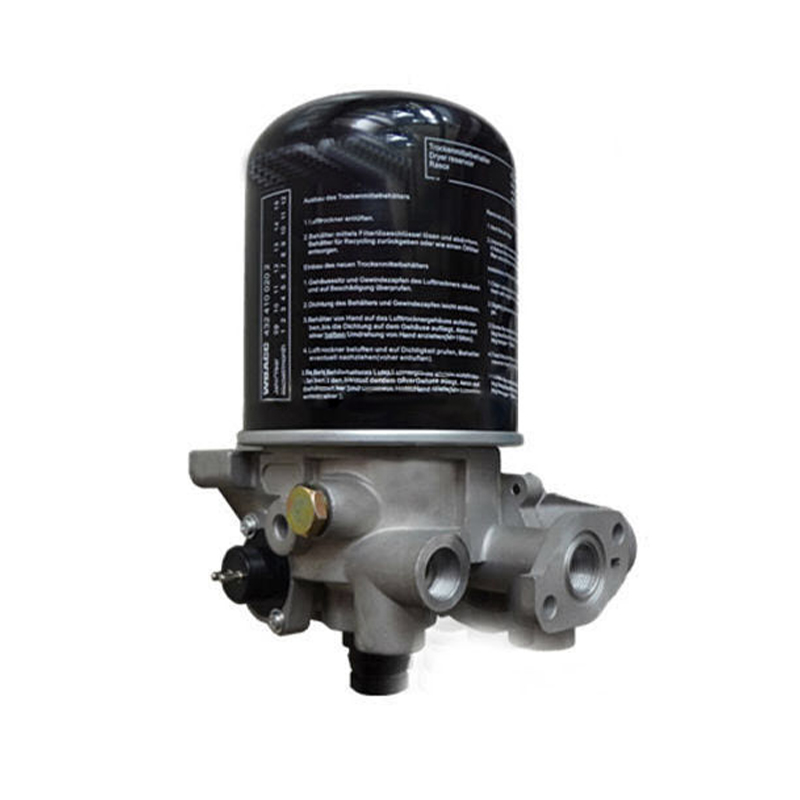 24V Heated Air Dryer Assembly for Heavy TrucksOEM-replacement 24V heated dryer with integrated pressure regulation and silencing, suited to cold-climate heavy truck air systems requiring stable cut-out.View Product →
Heated 24 volt assemblies are the default choice for European heavy trucks operating in temperate and cold climates. Confirm the heater wattage matches the original and that the connector keyway matches the vehicle harness before installation. A mismatched connector that has been forced on will heat intermittently under vibration and produce a fault that is almost impossible to reproduce in the workshop.
Capacity and duty cycle
Dryer capacity is matched to compressor output, not to vehicle size. A high-output compressor on a tipper or a refuse body produces more condensate per hour than a line-haul tractor, and fitting a standard capacity dryer to that duty shortens the desiccant life significantly. When replacing a unit on a high duty cycle vehicle, match or exceed the original capacity rather than matching the price.
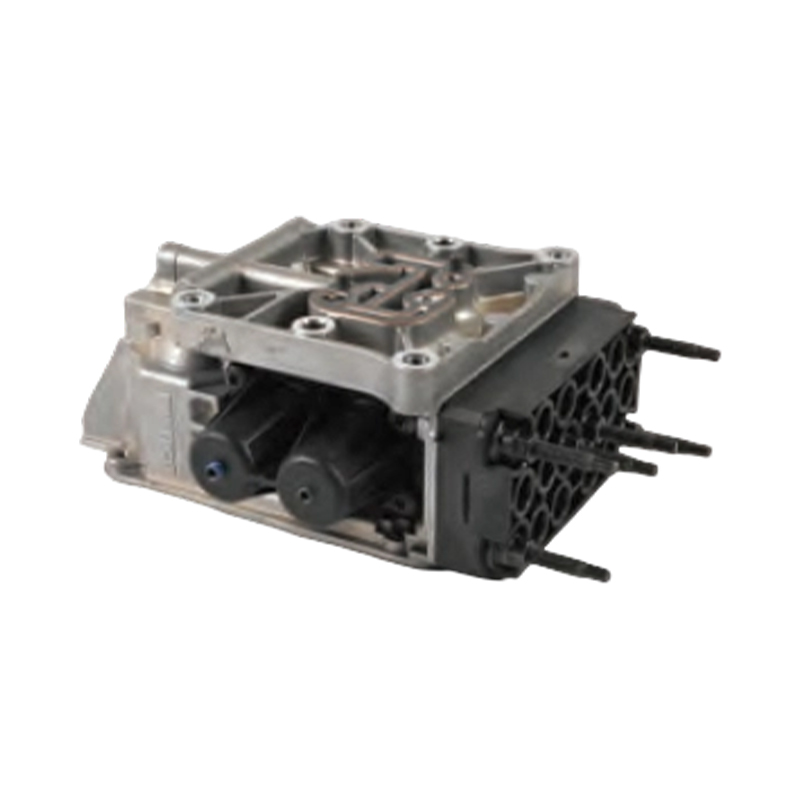 APU Multi-Circuit Pressure Control Unit for Commercial VehiclesIntegrated APU pressure distribution unit with tiered circuit opening pressures, offering a serviceable replacement where original harness and sensor connections must be retained.View Product →
Multi-circuit pressure control units are the practical choice where the original installation used an integrated APU. They combine the dryer, the four-circuit protection valve and the pressure limiting function in a single serviceable body, and they accept the original sensor and silencer connections so the vehicle harness needs no modification.
European and American Platform Differences That Affect Diagnosis
The two platform families behave differently in service, and knowing which one you are working on saves time during diagnosis.
- European trucks commonly use an integrated air processing unit with an electronic pressure sensor and a silencer. Fault codes often point at the sensor when the real problem is a saturated cartridge, because a blocked dryer produces pressure readings the ECU interprets as a sensor fault.
- American trucks more often use a standalone dryer with a separate governor and a four-circuit protection valve. Diagnosis is more mechanical: the governor signal, the purge behaviour and the delivery check valve each give a direct answer.
- Port and fitting standards differ, so a cartridge or assembly from one family will not fit the other without adapters. Confirm the platform before ordering, not after the old unit is off the vehicle.
- Heater control also differs. European installations frequently route heater control through the vehicle ECU, while American installations often use a simple thermostat in the dryer base. A heater that tests good but never receives voltage is usually an ECU or wiring issue on a European truck.
Service Intervals and What Actually Extends Dryer Life
| Item | Normal duty | Severe or high humidity duty | Check method |
|---|---|---|---|
| Reservoir drain test | Weekly | Daily | Drain into a cup after overnight stand |
| Purge cycle observation | Monthly | Weekly | Stopwatch at idle, engine warm |
| Cartridge replacement | 12 to 18 months | 6 to 12 months | Calendar plus drain test result |
| Heater circuit check | Before each winter | Before each winter | Multimeter across heater terminals |
| Purge valve seat inspection | 24 months | 12 months | Listen for continuous exhaust leak |
| Compressor oil carry-over check | 24 months | 12 months | White cloth at delivery port |
Three habits extend dryer life more than any part choice. First, drain the reservoirs on a schedule rather than when someone remembers, because standing water accelerates corrosion inside the tank and pushes rust particles into the valves. Second, keep the compressor's oil return line clear, since a blocked return line is the fastest route to a saturated desiccant bed. Third, never pour alcohol or anti-freeze into the air system to deal with winter icing. It carries moisture past the dryer, attacks seals throughout the circuit, and turns a two-hour repair into a week of recurring faults.
Common Mistakes During Diagnosis and Replacement
Judging the cartridge by colour
A saturated bead often looks identical to a fresh one. Capacity is measured by the drain test, not by appearance.
Replacing the dryer and ignoring the compressor
A compressor passing oil will destroy a new dryer within weeks. Fix the source before fitting the cure.
Skipping the leak-down test
A short purge cycle caused by a system leak will persist after a new dryer is fitted, and the new unit gets blamed.
Forcing mismatched connectors
A heater connector that does not key correctly will produce intermittent faults that no workshop can reproduce.
Reusing old seals
A hardened seal ring on a new cartridge leaks air past the bed and mimics total desiccant failure.
Ignoring the trailer
Trailer dryers and reservoirs fail on their own schedule. Diagnose the tractor and trailer separately.
Frequently Asked Questions
How long does an air dryer last before it needs replacing?
A cartridge typically lasts 12 to 18 months in normal line-haul service and 6 to 12 months in high humidity or high duty cycle work. The complete assembly commonly lasts five to eight years, provided the heater, purge valve and check valve are maintained. The drain test is a more reliable guide than the calendar.
Can I drive with a bad air dryer?
The vehicle will usually brake normally at first, because the reservoirs still hold pressure. The risk is cumulative. Moisture corrodes valve bores, freezes in winter and eventually reaches the brake chambers. A dryer that has failed completely can also prevent the system from reaching cut-out pressure, which limits how many brake applications remain available before the compressor catches up.
Why does my dryer purge so often?
Either the unloader seat is leaking, the system has an external leak, or the governor is set incorrectly. Run the ten-minute leak-down test first. If the system holds pressure, the fault is inside the dryer.
Why is there oil in my air tanks?
Oil in the tanks means oil has passed through the dryer. The compressor is passing oil, the coalescing element is saturated, or the oil return line is blocked. Replacing the dryer without addressing the compressor will not solve it.
Does a bigger air dryer improve brake performance?
Not directly. Brake performance depends on pressure and volume in the circuit. A correctly sized dryer keeps the air dry, which protects the valves and chambers that do the actual work. Oversizing brings no benefit and can change the purge behaviour of the system.
What causes beads to appear in the air line?
The support screen or felt pad inside the dryer has failed. This is a whole-assembly replacement, and every component downstream of the dryer outlet should be inspected and flushed before the vehicle returns to service.
Can a bad dryer cause a low pressure warning?
Yes. A restricted dryer body limits how quickly the compressor can refill the reservoirs, and on a vehicle with a high air demand the pressure can fall below the warning threshold during repeated brake applications. Confirm by repeating the build-up test with the dryer bypassed.
The five checks are deliberately simple, and each one answers a different question. The tank drain tells you whether the desiccant is still working. The purge cycle tells you whether the valve and the governor are still cooperating. The build-up time tells you whether the housing is restricting flow. The white cloth tells you whether the compressor is poisoning the bed. The multimeter tells you whether the unit will survive the winter. Run them in that order, write down the numbers, and the decision between a cartridge and a full assembly makes itself.
Our Main Products
Copyright © Zhejiang Gongzheng Machinery Co., Ltd. All Rights Reserved.
