Open the drain valve on a tractor's air tank after a humid night and water pours out. The brake pedal feels spongy, the air lines show a thin layer of frost, and the spring brake chamber on the trailer releases slower than it should. These are symptoms of one root cause: moisture inside the compressed air system. The component that prevents this damage is the compressed air dryer. It works by lowering the pressure dew point of the compressed air. Hot, saturated air from the compressor enters the dryer, where it is cooled so water vapor condenses into droplets, the liquid is separated and purged, and the air then passes through a desiccant bed that captures the remaining vapor before the air reaches the brake reservoirs. In a commercial vehicle, this process repeats on every compressor cycle, and when the dryer stops doing its job, the braking system is the first thing to suffer.
What a Compressed Air Dryer Does in a Truck Air Brake System
The air dryer sits between the compressor and the first reservoir, usually called the wet tank. Its task is to make sure the air stored in the reservoirs remains dry enough that no water condenses at the lowest temperature the vehicle will see in service. It also traps a portion of the oil and solid contaminants that travel with the compressed air, acting as the first line of protection for downstream valves and chambers.
When the compressor draws in atmospheric air, it also draws in water vapor. At 25°C and 60% relative humidity, every cubic meter of ambient air holds about 14 grams of water. A typical truck compressor with a free air delivery of 400 to 600 liters per minute can push 0.5 to 1.5 liters of water vapor into the brake system during an 8-hour shift, depending on the duty cycle. Without effective drying, that water condenses inside the tanks, flows into the foot brake valve and relay valves, washes grease from moving parts, corrodes the inside of spring brake chambers, and freezes in the lines when the temperature drops below zero.
The measure that describes how dry the air is called the pressure dew point. It is the temperature at which water vapor begins to condense at the current system pressure. For example, if a dryer delivers air with a pressure dew point of -20°C at 10 bar, condensation will not form until the air temperature falls to -20°C. A dryer rated to -40°C provides a large safety margin even in severe winter conditions. Regulatory standards for air brake systems, including FMVSS 121 in North America and ECE R13 internationally, require that brake systems remain functional across expected operating temperatures, which effectively mandates moisture removal from the compressed air supply.
How a Compressed Air Dryer Works
All compressed air dryers share the same goal: remove enough water vapor so the air stays dry at the lowest expected operating temperature. The way they achieve this depends on the technology. In commercial vehicle air brake systems, the dominant technology is the desiccant dryer, and its working principle can be described in three stages.
During the compression stroke, the air temperature rises to 150-180°C. At this temperature, the air holds far more water vapor than it can at ambient temperature. The first job of the dryer is to drop the temperature so the vapor condenses. The second job is to separate and eject the liquid water. The third job is to capture the remaining vapor that is still suspended in the air after separation.
Stage 1: Cooling and condensation
Hot air from the compressor enters the dryer housing and passes through a cooling section. In many truck dryers, the air follows a long path through a cooling coil or around a central bore where a finned heat exchanger dissipates heat. As the air temperature drops, its capacity to hold water vapor falls sharply. The excess vapor changes state and becomes tiny droplets of liquid water, exactly like the water that forms on a cold drink can in summer.
Stage 2: Moisture separation and purge
The droplets are heavier than the air stream, so they are thrown out of the flow by a change of direction, a baffle, or a centrifugal separator. The collected water falls into the bottom chamber of the dryer. From there, it is ejected during the purge phase. When the system pressure reaches the governor cut-out setting, the compressor unloads and the dryer vents to atmosphere. A purge valve opens for one to three seconds, and a small amount of dry compressed air from the reservoir expands backward through the dryer, pushing the collected water out through the purge exhaust. This is the puffing sound you hear from a truck air dryer during normal operation.
Stage 3: Desiccant adsorption
After separation, the air still contains water vapor. It then flows upward through a desiccant cartridge filled with activated alumina and, in some designs, a small amount of molecular sieve. These materials contain millions of microscopic pores, and the pore surfaces attract water molecules through adsorption. The water molecules cling to the pore walls and are held there physically, not chemically. The air leaving the top of the desiccant bed has a pressure dew point between -20°C and -40°C, depending on the media volume, the inlet temperature, and the air flow rate.
Regeneration: how the dryer resets itself
The desiccant is not consumed during the drying cycle, but it does reach a point where it can no longer hold more water. That is why the dryer regenerates. When the compressor unloads and the dryer vents to atmosphere, a portion of the dry air from the reservoir expands back through the desiccant bed in the reverse direction. Because the expanded air has an extremely low moisture content, it absorbs the water from the desiccant surface and carries it out through the purge valve. After a few seconds, the bed is dry and ready for the next cycle. This purge-regen process is fully automatic and driven by the pressure differential that already exists in the braking system.
Types of Compressed Air Dryers Compared
Desiccant dryers are not the only available technology. Different industries use different types of dryers, and it helps to understand where each one fits and why the desiccant design is used in trucks.
| Dryer type | Working principle | Typical pressure dew point | Common applications |
|---|---|---|---|
| Refrigerated | Air is cooled to around +3°C by a refrigeration circuit; condensate is separated and drained | +3°C to +10°C | Industrial stations, workshop air supplies, paint booths |
| Heatless desiccant | Two desiccant towers alternate between drying and expansion regeneration | -40°C | Trucks, buses, rail brakes, outdoor pipelines |
| Heated desiccant | Heaters reduce purge air consumption during regeneration | -40°C or lower | Large fleets, stationary systems with limited purge air |
| Membrane | Water vapor permeates selectively through membrane fibers and is vented away | -10°C to -30°C | Electronics, instrumentation, small vehicles |
| Deliquescent | Chemical salt tablets dissolve as they absorb water vapor; brine is drained | +5°C to +10°C | Remote gas installations, temporary systems |
Relative moisture level in compressed air after drying
Illustrative comparison indexed to untreated compressed air (100). Lower means drier air.
Refrigerated dryers are common in fixed industrial plants where the ambient temperature rarely drops below freezing. Membrane dryers suit low-flow applications that demand consistent dryness without power input. Deliquescent dryers are used where simplicity matters more than dew point performance. For trucks, buses, and trailers, the desiccant dryer is the only option that combines a -40°C dew point with a compact, self-contained package.
Why Desiccant Dryers Are the Standard for Commercial Vehicles
Trucks operate from desert heat to arctic cold. A refrigerated dryer can only lower the dew point to around +3°C, which means the air would become saturated as soon as the temperature dropped close to freezing. In a vehicle that parks overnight at -20°C, that would lead to condensation inside the brake valves and ice in the lines by morning.
Desiccant dryers solve this problem because they can achieve a pressure dew point of -40°C in a compact, vehicle-mounted package. The desiccant media does the work with no moving parts, and the purge cycle uses the pressure differential that already exists in the braking system. This makes the desiccant dryer self-contained, reliable across a wide temperature range, and straightforward to service.
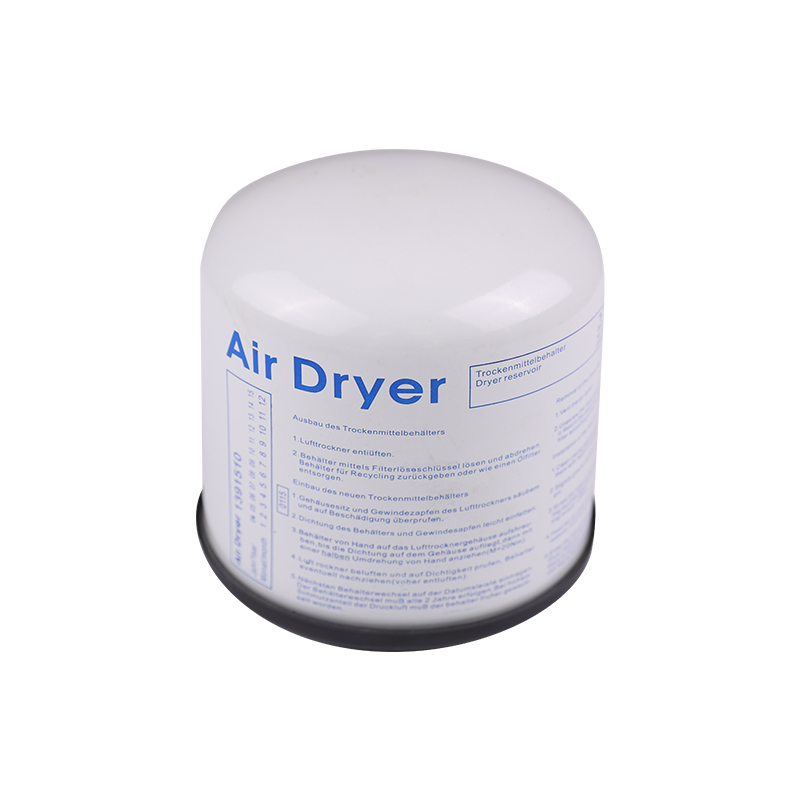
The heart of the system is the desiccant cartridge. When the cartridge becomes saturated, or the media begins to channel, the pressure dew point rises and moisture breaks through. This is why a fresh, high-quality cartridge is the most direct way to keep the air system dry. Understanding the difference between a working and a failing unit starts with knowing the role of the brake air dryer system in your vehicle's air circuit.
Selecting the Right Dryer for Your Fleet
Choosing a dryer for a truck or trailer comes down to matching drying capacity with compressor output and the operating environment.
Sizing basics
Start with the compressor free air delivery. The dryer must handle the maximum air flow the compressor can produce at rated pressure. An undersized dryer regenerates too often, has a higher pressure drop, and lets moisture break through earlier. An oversized dryer costs more and takes up extra space, but it is rarely a problem.
Pressure and climate
Most commercial vehicle air systems work between 8.5 and 12.5 bar. The dryer must be rated for the maximum system pressure, and the purge valve must be sized for that pressure range. For fleets operating in cold regions, a dryer with a built-in heater is recommended. The heater prevents the purge valve and the outlet check valve from freezing and helps regeneration at low ambient temperatures. Most truck dryers use a 12V or 24V heating element that activates when the ignition is on.
Mounting and ports
Finally, look at the port configuration and mounting position. The dryer inlet, outlet, and purge exhaust ports must match the vehicle's air plumbing. If you are replacing an existing unit, comparing the original part number is the fastest way to find the correct replacement.
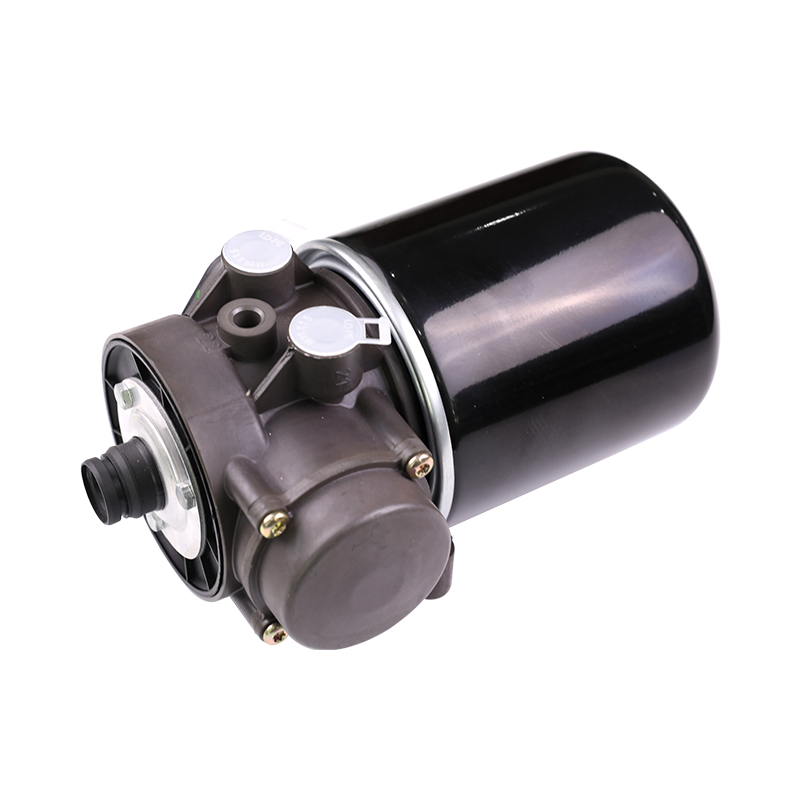
For vehicles with higher air consumption, such as tractors with air suspension and a trailer air supply, a dryer with a larger desiccant volume provides a longer service interval and more stable dew point control across the full duty cycle.
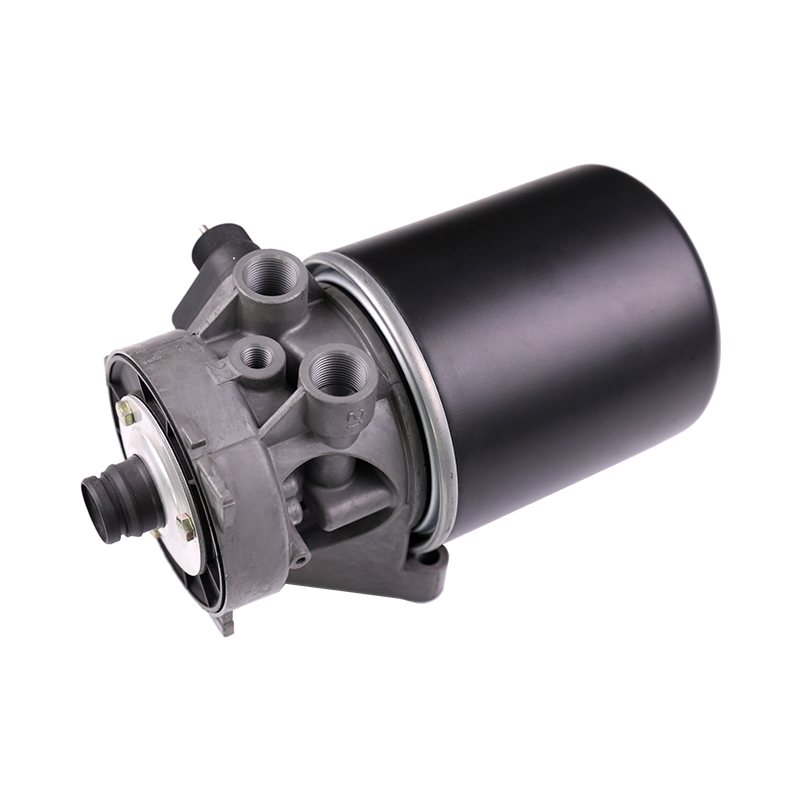
Signs That a Dryer or Cartridge Needs Service
Most dryer failures give visible warning signs before the braking system is affected. Checking for these signs during routine maintenance can prevent a roadside failure.
The most common maintenance action is replacing the air dryer cartridge. Most manufacturers recommend an interval of 12 to 24 months, or between 100,000 and 200,000 km. In high-humidity regions, or on vehicles with oil carry-over, shorten that interval. The sizing and selection details for replacement elements are covered in our guide to air dryer cartridges. If the dryer body itself is cracked, or the heater has failed, the whole assembly may need to be replaced; in that case, match the mounting, port size, and voltage to the original part number.
Frequently Asked Questions
How often should a truck air dryer cartridge be replaced?
Most manufacturers recommend every 12 to 24 months, or between 100,000 and 200,000 km, whichever comes first. Fleets operating in high humidity or in dusty environments should shorten the interval. If the compressor shows signs of oil carry-over, replace the cartridge immediately after the compressor is repaired.
What pressure dew point do I need for a commercial vehicle air brake system?
For general over-the-road operation, -20°C is the minimum recommended pressure dew point. For fleets that run in cold climates, a dryer rated to -40°C provides enough margin to prevent condensation and freezing even after long overnight stops.
Can a truck operate without an air dryer?
It will run for a while, but the damage is cumulative. Moisture condenses in the tanks, corrodes the valve internals, freezes in the lines in winter, and washes lubricant from the spring brake chambers. The resulting repairs, to say nothing of the downtime and safety risk, cost many times the price of a dryer.
Why is there oil in my air dryer?
Oil comes from the compressor. Worn piston rings, leaking shaft seals, or a clogged air intake filter let oil pass into the compressed air stream. Oil coats the desiccant beads and blocks the pores, so the desiccant can no longer trap water vapor. The compressor must be repaired before a new cartridge is fitted, or the new cartridge will fail just as quickly.
What does a healthy purge pulse sound like?
A healthy dryer produces a single sharp puff of air lasting one to three seconds when the compressor unloads. If the pulse is missing, weaker than usual, or continuous, the purge valve is blocked, the governor is not cycling properly, or the purge volume is too low for regeneration.
The compressed air dryer is an invisible component in the sense that a working one requires no attention. It sits between the compressor and the tanks, quietly lowering the dew point on every cycle. Understanding how it works gives you a diagnostic edge: you know why the purge pulse matters, why a cartridge wears out, and why moisture in a drain check is never a small problem. Watch the purge, drain the tanks, replace the cartridge on schedule, and choose parts that match the compressor output and the climate your vehicles operate in. That is the difference between an air brake system that works through the winter and one that fails at the worst possible moment.
Learn how compressed air dryers remove moisture from truck brake systems, protect valves from corrosion, and keep your air supply clean and dry.