


 Français
 Español
 中文简体
 русский

Gongzheng
Gongzheng
Gongzheng
Gongzheng
Gongzheng
Gongzheng
Gongzheng
Gongzheng
Gongzheng
Gongzheng
Gongzheng
Gongzheng
Gongzheng
Gongzheng
Gongzheng
Gongzheng

Content
- 1 Bad Air Dryer Symptoms: The System Fails in a Predictable Order
- 2 What "Bad" Means: Three Separate Failure Points
- 3 The 9 Most Reliable Symptoms of a Bad Air Dryer
- 3.1 1. Water Pools in the Reservoirs When You Drain Them
- 3.2 2. The Compressor Cycles More Often Than It Used To
- 3.3 3. Slow Brake Release or a Spongy Brake Pedal
- 3.4 4. Frozen Valves or Lines in Winter
- 3.5 5. Continuous Air Leak at the Purge Valve
- 3.6 6. Oily Film or Tar-Like Deposits in the Drain Air
- 3.7 7. Rust Flakes or Scale in the Reservoir Drains
- 3.8 8. ABS or EBS Warning Lights and Erratic Valve Behavior
- 3.9 9. Longer Crank Time Before the System Builds Pressure
- 4 How to Confirm the Diagnosis Before Replacing Parts
- 5 What Happens When You Keep Driving with a Bad Air Dryer
- 6 European and American Platforms Display Different Symptom Patterns
- 7 Service Intervals That Stop the Symptoms Before They Appear
- 8 Choosing the Right Replacement Dryer So the Symptoms Do Not Return
- 9 Bad Air Dryer Symptoms: Frequently Asked Questions
- 9.1 How can you tell if an air dryer is bad?
- 9.2 How long does a truck air dryer last before it goes bad?
- 9.3 Can I just replace the air dryer cartridge instead of the whole unit?
- 9.4 Why is there still water in the air tank after I install a new air dryer?
- 9.5 What causes oil in the truck air dryer?
- 9.6 Does a leaking air dryer purge valve affect braking?
Bad Air Dryer Symptoms: The System Fails in a Predictable Order
A truck that comes into the workshop with water spraying out of the reservoir drain almost always has an air dryer problem, but the dryer itself is usually the last component checked. The reason is simple: a failing air dryer does not stop the air system from building pressure. It stops cleaning the air. That is why the first symptoms of a bad air dryer are moisture symptoms, not pressure symptoms.
The air dryer on a commercial vehicle sits between the air compressor and the supply reservoir. During the charge phase, hot compressed air flows through a desiccant bed that absorbs water vapor, oil aerosols, and solid particles. When the governor reaches cut-out pressure, the compressor unloads and the dryer's purge valve blasts the collected water and oil out through a small exhaust port. Both phases have to work correctly for the brake system to receive dry, clean air. If the desiccant is saturated, the purge valve leaks, or the heater fails, moisture passes downstream and begins to attack every valve, chamber, and electronic modulator in the system.
Technicians describe a bad air dryer in three different ways, and the repair is different for each one. A desiccant cartridge that has become waterlogged needs to be replaced. A purge valve that sticks open needs a rebuild kit or a new base. A failed heater or governor usually means the whole assembly has to be swapped. Knowing which of these has failed matters more than replacing random parts. The symptoms below help you make that decision, and they are listed in the order a technician usually notices them, starting with the most direct piece of evidence. For a deeper look at the failure mechanism itself, read how air dryers develop these signs.
What "Bad" Means: Three Separate Failure Points
When a truck air dryer is called bad, technicians usually mean one of three things. Understanding which one you are dealing with changes the entire repair decision. A waterlogged cartridge can be replaced in 20 minutes. A broken purge valve can be repaired or exchanged. A failed heater or a faulty governor normally means that the whole unit has to be replaced. Start by identifying which failure layer you are looking at.
Desiccant Cartridge Saturation
The desiccant bed in the cartridge has a finite adsorption capacity. It can absorb only a certain weight of water before it stops working. The purge cycle removes most of that water every time the compressor unloads, but oil from a worn compressor can coat the desiccant beads and permanently block the adsorption process. Once the beads are oil-coated or saturated, the dryer passes moisture even though it still passes air. System pressure looks normal, but the air is wet. This is the most common form of a bad air dryer and the easiest one to miss on a pressure gauge.
Purge Valve Failure
The purge valve opens each time the compressor unloads. It releases a short blast of compressed air that carries the collected water and oil out of the dryer. If the purge valve diaphragm is damaged, contaminated, or held open by debris, the dryer can no longer regenerate itself. The desiccant stays wet, and the next charge phase pushes moisture straight into the reservoirs. A purge valve that sticks open also creates a continuous air leak, which forces the compressor to cycle more often and raises fuel consumption.
Governor and Heater Failure
On many integrated dryers, the governor is built into the same assembly. It controls compressor cut-in and cut-out pressures. A governor that drifts too low cuts the compressor back on repeatedly; a governor that drifts too high lets system pressure climb beyond the safety margin. The heater is a separate concern, especially in cold climates. When the heater fails, condensed moisture inside the dryer freezes in winter, blocks the airflow, and stops the system from building pressure at all. That failure mode is commonly misdiagnosed as a compressor problem.
The 9 Most Reliable Symptoms of a Bad Air Dryer
Use this list as a quick field checklist. The first three symptoms are direct evidence that the dryer is failing. The next three are strong indicators. The last three can have other causes, but the air dryer is always a prime suspect when they appear together or repeat after repairs. The line chart below shows a pattern many fleets see when the desiccant cartridge is left in service too long: the compressor cycle frequency climbs steadily as the dryer loses its ability to keep the purge valve sealed and the system dry.
Cycle frequency rises as the purge valve leak and wet desiccant force the system to rebuild pressure more often.
1. Water Pools in the Reservoirs When You Drain Them
Open the supply reservoir drain valve after the vehicle has been parked overnight. If water comes out before air, or is mixed with the first blast of air, the dryer is not removing moisture. A properly functioning dryer should produce virtually dry air, so even one tablespoon of water is a reliable warning. The water appears in the supply reservoir first, because that is where wet air goes immediately after leaving the dryer. When you see water here, the cartridge is already saturated or the purge valve is not regenerating the desiccant.
2. The Compressor Cycles More Often Than It Used To
A healthy truck compressor with a healthy dryer runs for roughly 90 to 150 seconds and then stays unloaded for several minutes. When the dryer purge valve leaks pressurized air continuously, the system loses air faster than the governor expects, so the compressor cuts back in sooner. A degraded dryer base with a leaking heater seal produces the same pattern. If the dash gauge shows pressure dropping and recovering in a tight loop while the vehicle is parked, the dryer is on the list of first suspects. Time the cycles with a stopwatch and compare them with the same model in your fleet.
3. Slow Brake Release or a Spongy Brake Pedal
Water in the air system does not stay in the tanks. It collects in brake valves, relay valves, and brake chambers. When a service brake valve diaphragm is coated with a mix of water, oil, and dust, it moves sluggishly. Drivers report a pedal that feels softer, brakes that take longer to release, or a truck that seems to creep forward after the pedal is released. The mechanism is debris and corrosion inside the valve, not a loss of pressure. Brake valve problems like this often disappear temporarily after a new air dryer is fitted, because the new dryer stops feeding moisture into the system.
4. Frozen Valves or Lines in Winter
In freezing weather, the first sign is usually a valve that will not move. Water that should have been removed by the dryer reaches the valves and freezes. The parking brake can fail to release, a service brake can refuse to apply, or a reservoir drain valve freezes shut. The most common locations are the foot brake valve and the relay valves, because their small internal passages freeze quickly. A heated air dryer prevents this in most cases; a non-heated dryer with intact desiccant prevents most of it too. If the same truck has ice problems every winter, the dryer is involved.
5. Continuous Air Leak at the Purge Valve
The purge valve should blow off for one or two seconds during the compressor unload cycle and then close completely. If air keeps hissing out of the dryer base after the compressor stops, the purge valve diaphragm is damaged, held open by debris, or the valve seat is contaminated with oil. That continuous leak produces two effects: the system bleeds air while the truck is stopped, and the next charge phase starts with low reservoir pressure, which makes the compressor run longer. A hiss that never stops is one of the easiest symptoms to find and one of the cheapest to fix.
6. Oily Film or Tar-Like Deposits in the Drain Air
When the drain air from the reservoirs smells of oil or leaves a dark film on a clean rag, the dryer is dealing with more oil carryover than the desiccant can absorb. A worn compressor, failing piston rings, or a faulty discharge valve lets oil pass into the air stream. The oil coats the desiccant beads and permanently destroys their ability to hold water. If a new cartridge is fitted to a truck with a worn compressor, the cartridge will fail again within weeks. This symptom means two repairs are needed: fix the compressor oil source and replace the dryer cartridge.
7. Rust Flakes or Scale in the Reservoir Drains
Rust flakes in the drain air mean the moisture problem has been going on for months. The inner surfaces of the steel reservoirs are already corroding, and the visible signs are small orange-brown flakes or a gritty slurry at the bottom of the drain valve. Once the reservoirs are rusted, the corrosion particles themselves travel downstream and score valve seats and regulator surfaces. The air dryer needs attention immediately, and the reservoirs need an internal inspection before they develop a dangerous weak spot.
8. ABS or EBS Warning Lights and Erratic Valve Behavior
ABS modulators, EBS axle modulators, and pressure sensors rely on clean dry air and stable pilot pressure. Water entering the pneumatic side of an electronic control unit can cause intermittent responses: a wheel that momentarily locks during a hard stop, a dump valve that opens by itself, or a stability system that reports a slow valve response. The electronic unit is often replaced before the real cause is found. If the fault code returns after a new modulator is installed, check the entire air supply path, starting with the air dryer.
9. Longer Crank Time Before the System Builds Pressure
A partially frozen dryer, a blocked heater area, or an oil-sludged dryer base all restrict airflow. The compressor pushes air against a restriction, so the gauge climbs more slowly. This is most obvious on a cold morning: the truck builds pressure normally after sitting in a warm shop, but takes noticeably longer when parked outside overnight. If the pressure buildup is slow and the dryer is cold, check the heater circuit and the internal condition of the dryer before blaming the compressor.
How to Confirm the Diagnosis Before Replacing Parts
A systematic check takes about 20 minutes and prevents wasted money on valves, modulators, or compressors that are not the problem. The order matters: start at the reservoirs and work backward toward the dryer. Perform the steps below in the order written, because each step tells you whether the next step is necessary.
- Drain the supply reservoir completely. Park the vehicle with the brakes released, open the drain valve, and capture the discharge on a clean rag. Let the compressor build pressure, then drain again. If water or oil appears in either discharge, continue with the test.
- Watch the purge cycle. Run the engine at idle and watch the dryer base as the compressor reaches cut-out. The purge valve should open with a sharp blast lasting 1 to 3 seconds, and the exhaust should stop completely.
- Listen for a purge valve leak. Shut the engine off and listen at the dryer exhaust port. A hiss that continues for more than 5 seconds after the purge cycle means the purge valve seat is contaminated or the diaphragm is damaged.
- Inspect the cartridge for oil. Remove the cartridge and look at the visible desiccant beads and the base plate. Dark, sticky beads with a strong oil smell indicate oil contamination from the compressor.
- Check the heater circuit. On a heated dryer, measure the resistance between the heater terminals with a multimeter. An open circuit means the heater element is burned out and needs replacement.
- Measure the compressor cycle time. Note how long the compressor runs to build pressure and how long it stays unloaded. If both intervals are short, look for a leak, usually at the purge valve or the dryer base gasket.
The table below gives a quick symptom-to-test reference. A dryer that fails at least two of these tests should be rebuilt or replaced. If only one test fails, the repair can be targeted: a leaking purge valve can be rebuilt, a saturated cartridge can be swapped, and a failed heater can be replaced if the base design allows it.
| Symptom | Most Reliable Test | Result That Confirms the Air Dryer |
|---|---|---|
| Water in reservoir drain | Drain test after overnight parking | Water appears before the air blast or mixed with it |
| Rapid compressor cycling | Watch pressure gauge at idle for 5 minutes | Cut-in cycles shorter than 90 seconds, repeated at least three times |
| Continuous purge hiss | Listen at the dryer exhaust port after purge | Hissing continues more than 5 seconds after the purge ends |
| Frozen valves in winter | Test dryer heater current draw | Heater shows open circuit or no current draw |
| Oil in drain air | Wipe drain air across a clean rag | Dark oil film is left on the rag |
| ABS or EBS fault codes | Read stored codes and check supply air pressure | Faults return after the modulator is replaced |
What Happens When You Keep Driving with a Bad Air Dryer
The damage does not stay inside the dryer. Water and contaminants move downstream in stages. During the first weeks the only visible effect is water in the reservoirs. By the second month the first brake valves begin to stick. By the sixth month brake chambers and ABS modulators lose performance. By the end of the first year the repair cost is several times the price of a new dryer assembly.
The bar chart below is based on typical workshop records and parts pricing for a class 8 truck. The exact numbers vary by manufacturer and region, but the trend is consistent: the cost of ignoring the symptoms grows much faster than the price of the replacement part.
Costs include valves, chambers, modulators, reservoirs, and the dryer itself, based on typical North American fleet parts pricing.
| Component Affected by Continued Moisture | Typical Repair Cost Range | When the Damage Appears |
|---|---|---|
| Air dryer cartridge or complete dryer assembly | $120 to $650 | At failure |
| Brake foot valve replacement | $180 to $420 | 2 to 4 months after moisture reaches it |
| Service brake relay valve replacement | $90 to $280 per valve | 2 to 5 months |
| Spring brake chamber replacement | $150 to $380 per chamber | 3 to 6 months |
| ABS or EBS axle modulator replacement | $400 to $1,100 per modulator | 4 to 8 months |
| Reservoir replacement due to internal corrosion | $300 to $900 per reservoir | 8 to 14 months |
| Total if the air dryer is ignored | $1,200 to $3,700 or more | Within 12 to 18 months |
The cost argument is strong for fleets, but the safety argument matters more for owner-operators. A truck that loses brake response because a waterlogged relay valve froze at -10 degrees Celsius cannot be repaired on the shoulder. The air dryer is a small component, but it is the only part between the compressor and every brake valve on the vehicle. When a bad air dryer is left in service, it does not just fail by itself; it takes the whole air system down with it.
European and American Platforms Display Different Symptom Patterns
Symptom patterns depend on the system layout. European trucks and trailers commonly use a multi-function air processing unit that combines the dryer, the four-circuit protection valve, pressure limiting valves, and sometimes the unloader valve in one housing. American trucks more often use a separate dryer assembly or a spin-on cartridge mounted on a base unit. Both layouts fail in the same fundamental ways, but you notice different symptoms first.
European-Style Integrated Air Processing Unit
When a European-style unit fails, the symptoms are not limited to the dryer. You may see a pressure imbalance between the supply circuits, a protection valve that opens too late, or a warning from the integrated pressure sensor because water has reached the sensor diaphragm. The shared housing spreads contamination quickly. The purge valve on these units also has a smaller exhaust passage, so a contaminated unit tends to hiss more audibly, and the hiss is easy to locate near the frame rail.
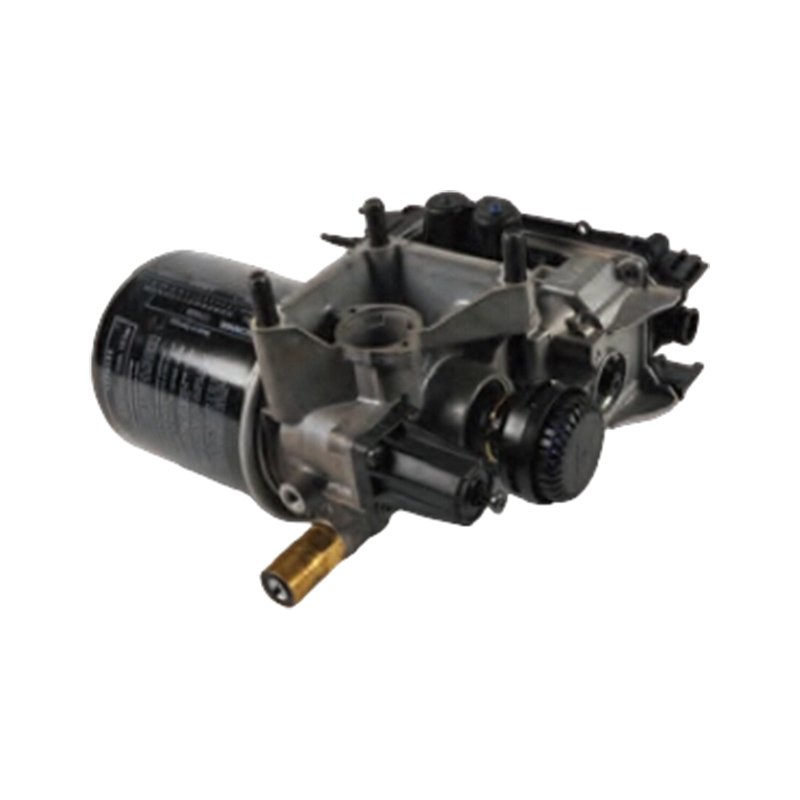
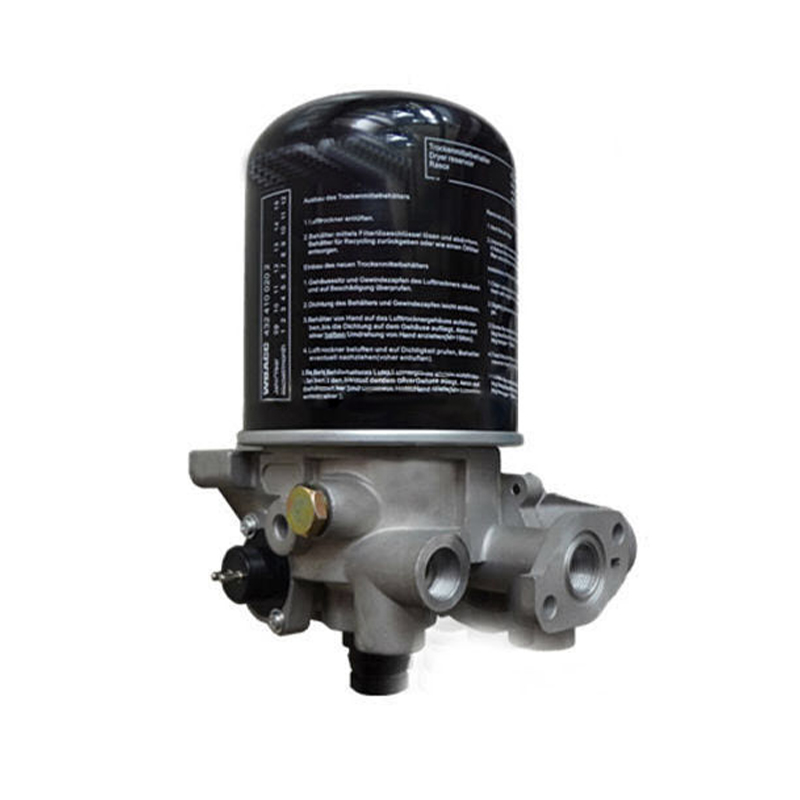 24V Heated Air Dryer Assembly for Heavy TrucksThis European-style unit integrates a heater and silencer to prevent ice and reduce noise, ideal for addressing the contamination spread and pressure imbalances described above.View Product →
American-Style Separate Dryer Assembly
On American-style dryers, the cartridge is more accessible, so visual inspection and cartridge replacement are quicker. The usual failure sequence starts with a leaking purge valve in the lower base, then a saturated cartridge, then a failed heater seal. Because the dryer is mounted close to the compressor on many American trucks, heat damage to the desiccant is more common; the cartridge bed slowly loses capacity and the system sees moisture at the drains even though the pressure stays normal.
Service Intervals That Stop the Symptoms Before They Appear
Most manufacturers recommend replacing the desiccant cartridge every two to three years or every 300,000 to 500,000 kilometers, whichever comes first. But the real life of a cartridge depends on the environment and the mechanical condition of the vehicle. The symptoms of a bad air dryer appear only after the cartridge is exhausted, so maintenance should happen before that point.
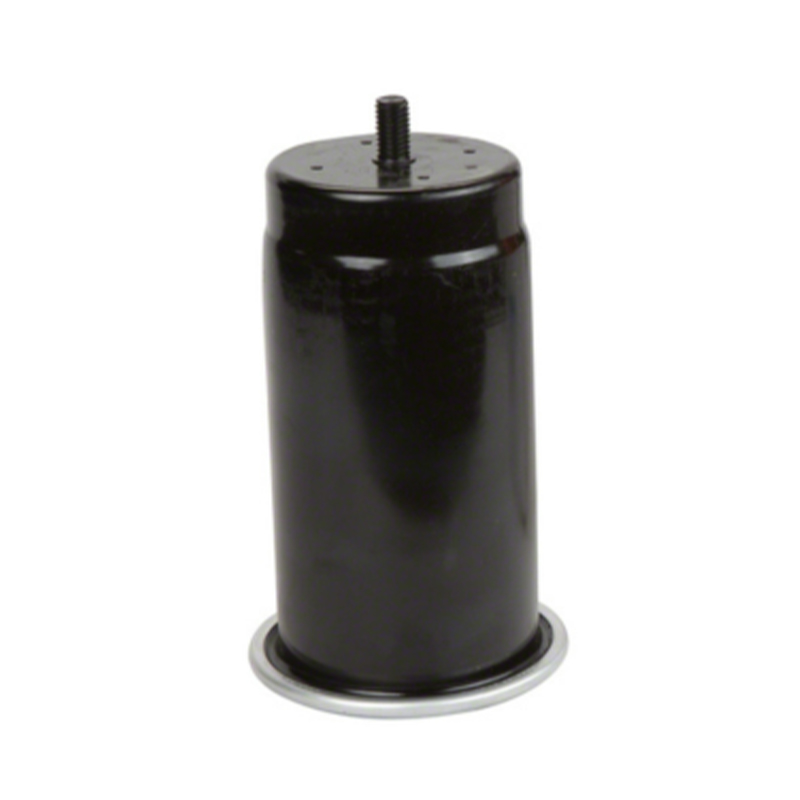 AD-9 Series Replacement Air Dryer CartridgeWith high-grade desiccant and enhanced coalescing, this cartridge directly addresses the oil and moisture damage that shortens service life, as discussed in the maintenance context.View Product →
| Service Item | Interval (Typical) | Notes |
|---|---|---|
| Desiccant cartridge replacement | Every 2 to 3 years or 300,000 to 500,000 km | Replace earlier if oil carryover is found |
| Purge valve operation check | Every oil change or 50,000 km | Listen for a sharp purge blast and a complete seal |
| Heater function check | Before winter, at least every 12 months | Measure resistance or current draw |
| Base gasket and mounting seals | At every cartridge change | Replace if hard, cracked, or deformed |
| Reservoir drain check | Daily or weekly depending on fleet policy | Water present means the dryer is failing |
| Compressor discharge valve condition | Whenever oil appears in the dryer | The oil source is usually the compressor |
Three factors shorten the life of an air dryer noticeably. A worn compressor that pumps oil is the fastest killer, because oil destroys the desiccant within weeks. High humidity regions put the desiccant under constant load, especially on coastal routes and in tropical climates. Heavy short-haul duty cycles also shorten cartridge life because the compressor cycles more often and the purge valve has less time to regenerate the bed fully. Fleets that check reservoir drains every week can adjust their own replacement interval based on actual moisture evidence.
Choosing the Right Replacement Dryer So the Symptoms Do Not Return
Replacing a bad air dryer with a mismatched unit brings back the same symptoms quickly. Match these specifications before you buy:
- Port configuration. Thread type and size on the compressor supply line and the delivery ports. NPT, BSP, M22, and Voss ports are common across different platforms.
- Electrical system voltage. The heater and any integrated sensor must match the vehicle's 12V or 24V system. A 12V heater on a 24V truck burns out immediately, and a 24V heater on a 12V truck barely warms up.
- Purge volume and regeneration capacity. A larger purge reservoir produces a stronger purge blast. If the purge volume is too small for the system, the desiccant never regenerates fully, and water returns to the system during the next charge phase.
- Integrated safety valve setting. Check the opening pressure. European air processing units, for example, are available in 10.5 bar and 12.3 bar versions; fitting the wrong one changes the pressure at which the system unloads.
- Mounting style and port orientation. The dryer base may be frame-mounted or bracket-mounted, and the inlet and outlet orientation affects the purge line routing. Confirm the physical layout before ordering.
- Cartridge family. Keep the cartridge family compatible with the base. A spin-on cartridge from the same family is usually the safest choice for a separate American-style unit.
A truck air dryer is the single most effective component for protecting the brake system, but it does not work alone. When you install a new dryer after a moisture-related failure, inspect the components downstream: the multi-circuit protection valve, the pressure limiting valve, and the brake valves in each circuit. They have already been exposed to the same moisture and should be checked at the same time. Start with heavy-duty truck air dryer assemblies to see the range of configurations available for your platform.
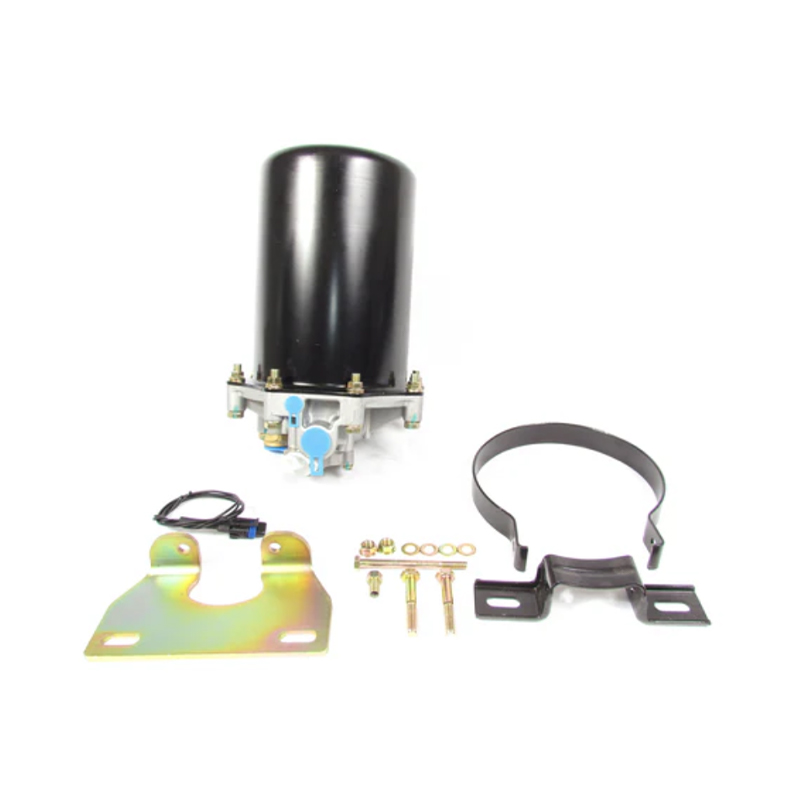 Heavy-Duty AD-9 Series Air Dryer Assembly with BracketThis complete assembly, including a purge valve and heater, is the right component to inspect and replace when moisture has affected downstream brake valves, matching the preceding guidance.View Product →
Bad Air Dryer Symptoms: Frequently Asked Questions
How can you tell if an air dryer is bad?
The most reliable signs are water in the reservoir drains, oil residue in the drained air, a hissing purge valve, and compressor cycling that is noticeably shorter than the normal duty cycle. Any one of these signs justifies inspecting the air dryer before replacing other brake components.
How long does a truck air dryer last before it goes bad?
A dryer assembly typically lasts around three years, while the desiccant cartridge should be replaced every two to three years or every 300,000 to 500,000 kilometers in normal conditions. High humidity, oil carryover from the compressor, and short-haul operating cycles all shorten that interval.
Can I just replace the air dryer cartridge instead of the whole unit?
Yes, when the base, heater, purge valve, and governor are still functional. If the purge valve leaks or the heater has failed, a cartridge-only repair will not solve the symptom. Base your decision on the diagnostic tests listed earlier, especially the purge leak test and the heater resistance check.
Why is there still water in the air tank after I install a new air dryer?
Usually one of three reasons: the reservoir already contained water that was not fully drained before the test; the compressor is passing oil that destroys the new cartridge quickly; or the new dryer is not matched to the system, meaning the wrong purge volume or port size. Also verify that the purge valve exhaust is not blocked.
What causes oil in the truck air dryer?
Oil in the air dryer normally comes from the compressor itself. Worn piston rings, a broken discharge valve, or a restrictor problem allows oil to be carried into the compressed air stream. The desiccant absorbs the oil and stops absorbing water, so the dryer appears to fail even though it is a victim rather than the root cause.
Does a leaking air dryer purge valve affect braking?
A leaking purge valve reduces the air pressure available while the vehicle is parked or idling. The compressor cycles more often, fuel consumption rises, and the brake system receives air that is less dry because the purge valve cannot build enough internal pressure to eject the collected moisture. If the leak is severe, the compressor can run almost continuously and brake response can become sluggish.
Our Main Products
Copyright © Zhejiang Gongzheng Machinery Co., Ltd. All Rights Reserved.
